Imperial Conquest: America’s “Long War” against Humanity
Global Research, January 29, 2014
The following text was presented at the Rosa Luxemburg Conference, Berlin, January 11, 2014.
The event was organized by the German daily “junge Welt”. This year, the Rosa Luxemburg Conference marked the commemoration of the 100th anniversary of the First World War.
In this regard, the history of wars is important because it helps us understand today’s wars.
Our objective is World Peace. Our objective is to criminalize war.
The concept of the Long War is part of US military doctrine since the end of World War II. In many regards, todays wars are a continuation of the Second World War.
Worldwide militarization is also part of a global economic agenda, namely the application of the neoliberal economic policy model which has led to the impoverishment of large sectors of the World population.
Michel Chossudovsky, Berlin, January 11, 2014
Introduction
The world is at the crossroads of the most serious crisis in modern history. The US has embarked on a military adventure, “a long war”, which threatens the future of humanity. This “war without borders” is being carried out at the crossroads of the most serious economic crisis in World history, which has been conducive to the impoverishment of large sectors of the World population.
The Pentagon’s global military design is one of world conquest. The military deployment of US-NATO forces is occurring in several regions of the world simultaneously.
The concept of the “Long War” has characterized US military doctrine since the end of World War II. Worldwide militarization is part of a global economic agenda. 
General Wesley Clark (right)
Militarization at the global level is instrumented through the US military’s Unified Command structure: the entire planet is divided up into geographic Combatant Commands under the control of the Pentagon. US Strategic Command (USSTRATCOM) Headquarters in Omaha, Nebraska plays a central role in coordinating military operations.
According to former NATO Commander General Wesley Clark, the Pentagon’s military road-map consists of a sequence of war theatres:
“[The] five-year campaign plan [includes]… a total of seven countries, beginning with Iraq, then Syria, Lebanon, Libya, Iran, Somalia and Sudan.” (Democracy Now, 2007)

The ongoing war on Syria is a stepping stone towards a war on Iran, which could lead to a process of military escalation.
Russia and China, which are allies of both Syria and Iran, are also targeted by US-NATO. In the wake of the Cold War, nuclear weapons are no longer a weapon of last resort (deterrence), their use is now contemplated in the conventional war theatre.
The road to Tehran goes through Damascus. A US-NATO sponsored war on Iran would involve, as a first step, a destabilization campaign (“regime change”) including covert intelligence operations in support of Al Qaeda affiliated rebel forces directed against the Syria.
The geopolitics of oil and oil pipelines is crucial in the conduct of these military operations. The broader Middle East- Central Asian region encompasses more than 60 percent of the World’s oil reserves.
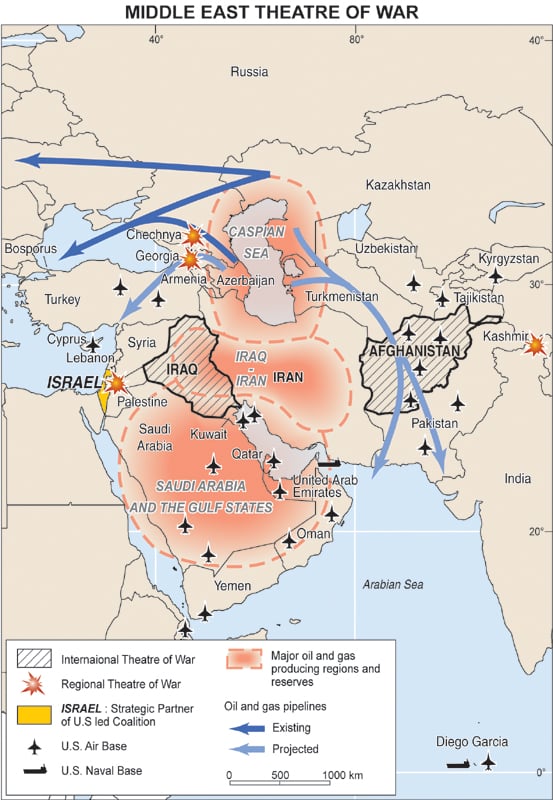
© Map by Eric Waddell, Global Research, 2003. (click to enlarge)
There are at present five distinct war theatres in the Middle East Central Asian region: Afghanistan-Pakistan, Iraq, Palestine, Libya and Syria.
An all out military attack on Syria would lead to the integration of these separate war theaters, eventually leading towards a broader Middle East-Central Asian war, engulfing an entire region from North Africa and the Mediterranean to Afghanistan, Pakistan and China’s Western frontier.
The 2000 Project for the New American Century (PNAC), first formulated by the NeoCons, was predicated on “waging a war without borders”.
The PNAC’s declared objectives were to “fight and decisively win multiple, simultaneous major theater wars” in different regions of the world as well as perform the so-called military “constabulary” duties “associated with shaping the security environment in critical regions”. Global constabulary implies a worldwide process of military policing and interventionism, including covert operations and “regime change”, all of which are carried out in accordance with a “humanitarian mandate”.

Military actions are implemented simultaneously in different regions of the world (as outlined in the PNAC) as well as sequentially.
This military agenda undertaken under the banner of “Responsibility to Protect” largely prevails under the Obama presidency. Media propaganda has been instrumental is sustaining the fiction of humanitarian warfare.
The Legacy of World War II. Demise of Competing Imperialist powers
What is referred euphemistically as the “post war era” is in fact a period of continuous wars and militarization. This must be understood when focussing on contemporary US led wars.While commemorating World War I, it is also important to understand that there is a continuum of US military strategies going back to World War I and the inter-war period.
The US emerges in the wake of the Second World War unscathed. Most of the fighting was conducted by its allies, a strategy which the US has used consistently in post-world war II conflicts. Moreover, a careful examination of World War II suggests that US corporate interests including Rockefeller’s Standard Oil supported both its allies and its enemies including Nazi Germany well beyond the US’s entry into World War II in 1941. The strategic objective was to weaken both sides, namely to destabilize competing imperialist powers.
Emerging as the victor nation in the wake of World War II, the US has determined the political and economic contours of post-War Western Europe. US troops are stationed in several European countries. Both its World War II adversaries (Germany, Japan, Italy) as well as its allies (France, U.K. Belgium, the Netherlands) have been weakened. With the exception of the U.K. which is part of the Anglo-American axis, these countries are outgoing colonial powers, displaced by US hegemony. Their pre-World War II colonial territories including Indonesia, The Congo, Indochina, Rwanda (among others) have been gradually integrated over a period of half a century into a dominant US sphere of influence.
In Africa, the process of displacement of France’s sphere of influence is still ongoing. The US is currently taking over the control of France and Belgium’s former colonies in Central Africa and West Africa. Washington also exerts a decisive role in the Maghreb.
“Internal Colonialism” in the European Union
A complex form of “internal colonialism” is also emerging in the European Union. US financial institutions and business conglomerates together with their European partners are prevalent in setting both the monetary, trade and investment agenda.
Politics are subordinated to dominant financial interests. What is also unfolding in terms of secret trade negotiations (under the TTIP and CETA), is a process of economic and political integration between the EU and North America. These agreements together with the Trans-Pacific Partnership (TPP) constitute the building blocks of a process of global economic domination.
Meanwhile, presidential and parliamentary elections in the EU, including Germany, Italy and France (e.g. Sarkozy and Hollande) are increasingly the object of covert political interference (modeled on the color revolutions), namely US sponsored regime change. The fundamental question is to what extent are European leaders political proxies.
US Sponsored Wars and Military Intelligence Operations
This entire period (1945- present) has been marked by a succession of US sponsored wars and military-intelligence interventions in all major regions of the World.
We are not dealing with piecemeal military operations pertaining to specific countries and regions: There is a military roadmap, a sequence of military operations. Non-conventional forms of intervention including State sponsored terrorist attacks rather than theater war have also been launched.
America’s war is a cohesive and coordinated plan of Worldwide military conquest which serves dominant financial and corporate interests. The structure of alliances including NATO is crucial.
The European Union plays a central role in this military agenda. The member states of the EU are allies of the Anglo-American axis, but at the same time, a restructuring process is occurring within the EU, whereby previously sovereign countries are increasingly under the jurisdiction of powerful financial institutions.
The imposition of the IMF’s deadly economic reforms on several European countries is indicative of America’s interference in European affairs. What is at stake is a major shift in EU political and economic structures, whereby member states of the EU are de facto re-categorized by the IMF and treated in the same way as an indebted Third World country.
Military Strategy
While the US has intervened militarily in major regions of the World, the thrust of US foreign policy is to have these wars fought by America’s allies or to resort to non-conventional forms of warfare.
The thrust of this agenda is twofold.
1) US military might is coupled with that of “Global NATO” including Israel. We are dealing with a formidable force, in terms of advanced weapons systems. US military bases have been established in all major regions of the World under the geographical command structure. A new African command has been established.
2) Military action supports powerful economic and financial interests. A strategy of “Economic Warfare” under the neoliberal agenda is implemented in close coordination with military planning.
The purpose of warfare is not conquest per se. The US lost the Vietnam war, but the ultimate objective was to destroy Vietnam as a sovereign country. Vietnam together with Cambodia today constitute a new impoverished frontier of the global cheap labor economy.
The imperial project is predicated on economic conquest, implying the confiscation and appropriation of the wealth and resources of sovereign countries. In the Middle East, successive wars have been geared towards the confiscation of oil and gas reserves.
Countries are destroyed, often transformed into territories, sovereignty is foregone, national institutions collapse, the national economy is destroyed through the imposition of “free market” reforms under the helm of the IMF, unemployment becomes rampant, social services are dismantled, wages collapse, and people are impoverished.
The ruling capitalist elites in these countries are subordinated to those of the US and its allies. The nation’s assets and natural resources are transferred into the hands of foreign investors through a privatization program imposed by the invading forces.
Historical Background: Nuclear Weapons. The Legacy of Hiroshima and Nagasaki
America’s early nuclear weapons doctrine under the Manhattan Project was not based on the Cold War notions of “Deterrence” and “Mutually Assured Destruction” (MAD). Contemporary post Cold War US nuclear doctrine is based on the notion that nuclear weapons can be used in the conventional war theater and that these weapons are “harmless to civilians”.
The strategic objective in the use of both conventional and nuclear attacks has been to trigger “mass casualty producing events” resulting in tens of thousands of deaths.
This strategy first applied during World War II in Japan and Germany was to terrorize an entire nation, as a means of military conquest.
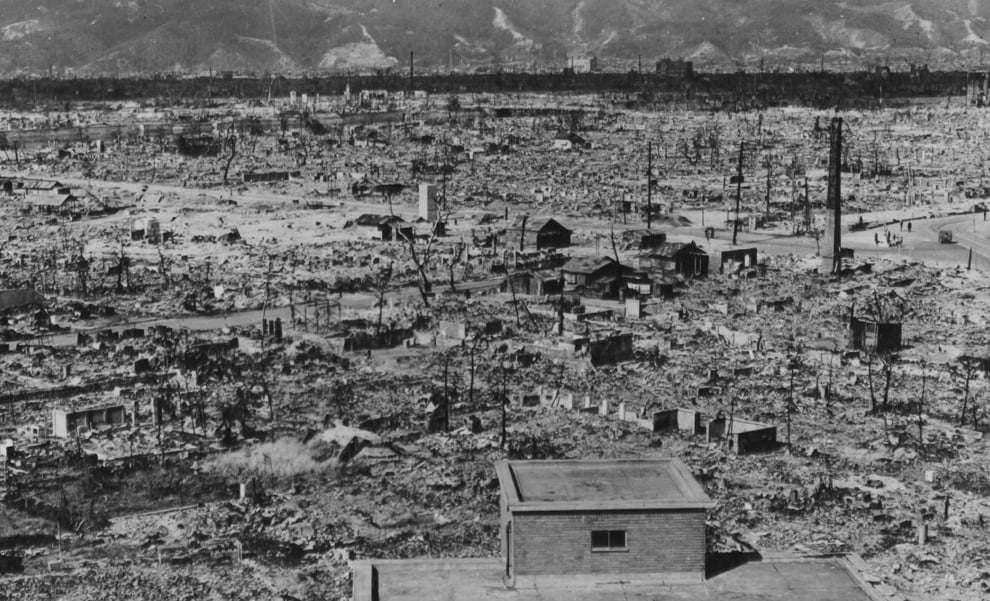
In Japan, military targets were not the main objective: the notion of “collateral damage” was used as a justification for the mass killing of civilians, under the official pretence that Hiroshima was “a military base” and that civilians were not the target.
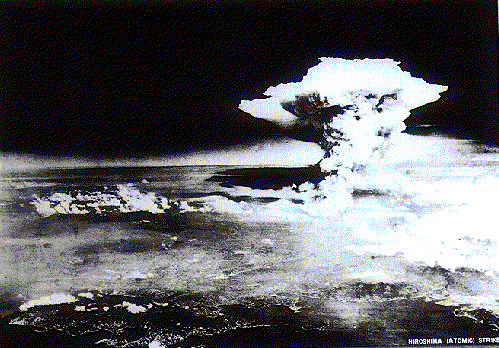
In the words of president Harry Truman:
“We have discovered the most terrible bomb in the history of the world. … This weapon is to be used against Japan … [We] will use it so that military objectives and soldiers and sailors are the target and not women and children. Even if the Japs are savages, ruthless, merciless and fanatic, we as the leader of the world for the common welfare cannot drop that terrible bomb on the old capital or the new. … The target will be a purely military one…
“It seems to be the most terrible thing ever discovered, but it can be made the most useful.” 20 (President Harry S. Truman, Diary, July 25, 1945)
“The World will note that the first atomic bomb was dropped on Hiroshima a military base. That was because we wished in this first attack to avoid, insofar as possible, the killing of civilians..” (President Harry S. Truman in a radio speech to the Nation, August 9, 1945).
[Note: the first atomic bomb was dropped on Hiroshima on August 6, 1945; the Second on Nagasaki, on August 9, on the same day as Truman's radio speech to the Nation]

Harry Truman
Nobody within the upper echelons of the US government and military believed that Hiroshima was a military base, Truman was lying to himself and to the American public.
To this day, the use of nuclear weapons against Japan is justified as a necessary cost for bringing the war to an end and ultimately “saving lives”.
Prior to Hiroshima, the US extensively used fire bombs in Japan resulting in large civilian casualties. In Germany, allied forces extensively bombed and destroyed German cities in the latter part of the war targeting civilians rather than military installations.
The US nuclear weapons arsenal has grown considerably. In the post Cold era, ArmsControl.org (April 2013) confirms that the United States
“possesses 5,113 nuclear warheads, including tactical, strategic, and non-deployed weapons.”
According to the latest official New START declaration, out of more than 5113 nuclear weapons,
“the US deploys 1,654 strategic nuclear warheads on 792 deployed ICBMs, SLBMs, and strategic bombers…
Moreover, according to The Federation of American Scientists (FAS) the U.S. possesses 500 tactical nuclear warheads, many of which are deployed in non-nuclear states including Germany, Italy, Turkey, Belgium, the Netherlands.
The History of War Crimes
The notion of mass casualty producing events prevails to this date in US military strategies. Invariably, as in the case of Syria, the civilian casualties of war committed by the aggressor are blamed on the victims.
The period extending from the Korean war to the present is marked by a succession of US sponsored theatre wars (Korea Vietnam, Cambodia, Afghanistan, Iraq, and Yugoslavia), various forms of military intervention including low intensity conflicts, “civil wars” (The Congo, Angola, Somalia, Ethiopia, Rwanda, Sudan), military coups, US sponsored death squadrons and massacres (Chile, Guatemala, Honduras, Argentina, Indonesia, Thailand, Philippines), covert wars led by US intelligence, US-NATO sponsored military intervention in Libya (using Al Qaeda rebels as their foot soldiers sponsored by Western intelligence).
The war on Syria is essentially a covert war of aggression whereby the Western military alliance and its GCC partners are supporting a terrorist insurgency. The objective is to destabilize Syria as a nation state.
The objective has not been to win these wars but in essence to destabilize these countries as nation states as well as impose a proxy government which acts on behalf of Western interests. Accounting for these various operations, the United States has attacked, directly or indirectly, some 44 countries in different regions of the developing world, since August 1945, a number of them many times (Eric Waddell, 2003):
“The avowed objective of these military interventions has been to effect ‘regime change’. The cloaks of “human rights” and of “democracy were invariably evoked to justify what were unilateral and illegal acts.” (Eric Waddell, 2003)
Destroying Internationalism: The Truman Doctrine
The broader objective of global military dominance in the wake of World War II in support of an imperial project was formulated under the Truman administration in the late 1940s at the outset of the Cold War. It was reaffirmed by US President George Herbert Walker Bush in a historical 1990 address to a joint session of the US Congress and the Senate in which he proclaimed a New World Order emerging from the downfall of the Berlin Wall and the disintegration of the Soviet block.
The ideological underpinning of this agenda are to be found in what is known as the “Truman Doctrine”, first formulated by foreign policy adviser George F. Kennan in a 1948 in a State Department brief.

George Kennan
What this 1948 document conveys is continuity in US foreign policy, from “Containment” during the Cold War to “Pre-emptive” Warfare and “War on Terrorism”. It states in polite terms that the US should seek economic and strategic dominance through military means:
Furthermore, we have about 50% of the world’s wealth but only 6.3% of its population. This disparity is particularly great as between ourselves and the peoples of Asia. In this situation, we cannot fail to be the object of envy and resentment. Our real task in the coming period is to devise a pattern of relationships which will permit us to maintain this position of disparity without positive detriment to our national security. To do so, we will have to dispense with all sentimentality and day-dreaming; and our attention will have to be concentrated everywhere on our immediate national objectives. We need not deceive ourselves that we can afford today the luxury of altruism and world-benefaction. (…)
In the face of this situation we would be better off to dispense now with a number of the concepts which have underlined our thinking with regard to the Far East. We should dispense with the aspiration to “be liked” or to be regarded as the repository of a high-minded international altruism. We should stop putting ourselves in the position of being our brothers’ keeper and refrain from offering moral and ideological advice. We should cease to talk about vague and—for the Far East—unreal objectives such as human rights, the raising of the living standards, and democratization. The day is not far off when we are going to have to deal in straight power concepts. The less we are then hampered by idealistic slogans, the better (George f. Kennan, 1948 State Department Brief)
The planned disintegration of the United Nations system as an independent and influential international body has been on the drawing board of US foreign policy since the inception of the United Nations in 1946. Its planned demise was an integral part of the Truman doctrine as defined in 1948. From the very inception of the UN, Washington has sought on the one hand to control it to its advantage, while also seeking to weakening and ultimately destroy the UN system.
In the words of George Kennan:
“Occasionally, it [the United Nations] has served a useful purpose. But by and large it has created more problems than it has solved, and has led to a considerable dispersal of our diplomatic effort. And in our efforts to use the UN majority for major political purposes we are playing with a dangerous weapon which may some day turn against us. This is a situation which warrants most careful study and foresight on our part. (George Kennan, 1948)In our efforts to use the UN majority for major political purposes we are playing with a dangerous weapon which may some day turn against us. This is a situation which warrants most careful study and foresight on our part. (George Kennan, 1948)
Although officially committed to the “international community”, Washington has largely played lip service to the United Nations. Today the UN is in many regards an appendage of the US State apparatus. Rather than undermining the UN as an institution, the US and its allies exert control over the Secretariat and key UN agencies. Since Gulf War I, the UN has largely acted as a rubber stamp. It has closed its eyes to US war crimes, it has implemented so-called peacekeeping operations on behalf of the Anglo-American invaders, in violation of the UN Charter. Following the de facto “dismissal” of Secretary General Boutros Boutros Ghali, UN Secretaries General Kofi Annan and Ban ki Moon have became a tool of US foreign policy, taking their orders directly from Washington.
Building a US Sphere of Influence in East and South East Asia
The Truman doctrine discussed above was the culmination of a post World War II US military strategy initiated with the nuclear bombing of Hiroshima and Nagasaki in August 1945 and the surrender of Japan.
In East Asia it consisted in the post-war occupation of Japan as well the US takeover of Japan’s colonial Empire including South Korea (Korea was annexed to Japan under the 1910 Japan–Korea Annexation Treaty).
Following Imperial Japan’s defeat in World War II, a US sphere of influence throughout East and South East Asia was established in the territories of Japan’s former “Great East Asia Co-Prosperity Sphere”.
America’s hegemony in Asia was largely based on establishing a sphere of influence in countries under the colonial jurisdiction of Japan, France and the Netherlands.
The US sphere of influence in Asia –which was built up over a period of more than 20 years– included the Philippines (a US possession which was occupied by Japan during World War II), South Korea (annexed to Japan in 1910), Thailand (a Japanese protectorate during World War II), Indonesia (a Dutch colony occupied by Japan during World War II, which becomes a de facto US proxy State following the establishment of the Suharto military dictatorship in 1965).
This US sphere of influence in Asia also extended its grip into France’s former colonial possessions in Indochina, including Vietnam, Laos and Cambodia, which were under Japanese military occupation during World War II.
Obama’s “Pivot to Asia” which overtly threatens China is the endgame of this historical process.
The Korean War (1950-1953) was the first major military operation undertaken by the US in the wake of World War II, launched at the very outset of what was euphemistically called “The Cold War”. In many respects it was a continuation of World War II, whereby Korean lands under Japanese colonial occupation were, from one day to the next, handed over to a new colonial power, the United States of America.
In South Korea on September 8, 1945, three weeks after the surrender of Japan on August 15th 1945. Moreover, Japanese officials in South Korea assisted the US Army Military Government (USAMG) (1945-48) led by General Hodge in ensuring this transition. Japanese colonial administrators in Seoul as well as their Korean police officials worked hand in glove with the new colonial masters.
While Japan was treated as a defeated Empire, South Korea was identified as a colonial territory to be administered under US military rule and US occupation forces. America’s handpicked appointee Sygman Rhee was flown into Seoul in October 1945, in General Douglas MacArthur’s personal airplane.
The bombing raids directed against civilians in Japan and Germany at the end of World War II as well as the War on Korea (1950-53) had set the stage for the implementation ofmass casualty producing events: extensive crimes were committed by US forces. US Major General William F Dean “reported that most of the North Korean cities and villages he saw were either rubble or snow-covered wastelands”
General Curtis LeMay [left] who coordinated the bombing raids against North Korea brazenly acknowledged that:
“Over a period of three years or so we killed off – what – twenty percent of the population. … We burned down every town in North Korea and South Korea, too”.
According to Brian Willson:
It is now believed that the population north of the imposed 38th Parallel lost nearly a third its population of 8 – 9 million people during the 37-month long “hot” war, 1950 – 1953, perhaps an unprecedented percentage of mortality suffered by one nation due to the belligerence of another.”
North Korea has been threatened of an attack with US nuclear weapons for more than 60 years.

From the Truman Doctrine to Clinton, Bush and Obama
There has been continuity throughout the post-war era, from Korea and Vietnam to the present.
The Neo-conservative agenda under the Bush administration should be viewed as the culmination of a (bipartisan) “Post War” foreign policy framework, which provides the basis for the planning of the contemporary wars and atrocities including the setting up of torture chambers, concentration camps and the extensive use of prohibited weapons directed against civilians.
Under Obama, this agenda has become increasingly cohesive with the legalization of extrajudicial killings of US citizens under the anti-terrorist legislation, the extensive use of drone attacks against civilians, the massacres ordered by the US-NATO-Israel alliance directed against Syrian civilians.
From Korea, Vietnam and Afghanistan, to the CIA sponsored military coups in Latin America and Southeast Asia, the objective has been to ensure US military hegemony and global economic domination, as initially formulated under the “Truman Doctrine”. Despite significant policy differences, successive Democratic and Republican administrations, from Harry Truman to Obama have carried out this global military agenda.
This entire “post war period” is marked by extensive war crimes resulting in the death of more than twenty million people. This figure does not include those who perished as a result of poverty, starvation and disease.
What we are dealing with is a criminal US foreign policy agenda. Media propaganda has served to obfuscate this agenda. US interventionism is invariably upheld as a humanitarian endeavor. Meanwhile, so-called progressive leftists and “anti-war activists” supported by corporate foundations have upheld this agenda on humanitarian grounds.
Criminalization does not pertain to one or more heads of State. It pertains to the entire State system, it’s various civilian and military institutions as well as the powerful corporate interests behind the formulation of US foreign policy, the Washington think tanks, the creditor institutions which finance the military machine.
War crimes are the result of the criminalization of the US State and foreign policy apparatus. We are dealing specifically with individual war criminals, but with a process involving decision makers acting at different level, with a mandate to carry out war crimes, following established guidelines and procedures.
What distinguishes the Bush and Obama administrations in relation to the historical record of US sponsored crimes and atrocities, is that the concentration camps, targeted assassinations and torture chambers are now openly considered as legitimate forms of intervention, which sustain “the global war on terrorism” and support the spread of Western democracy.
The Wars of the 21st Century: From the Cold War to the “Global War on Terrorism”
The alleged mastermind behind the 9/11 terrorists attacks, Saudi-born Osama bin Laden, was recruited during the Soviet-Afghan war, “ironically under the auspices of the CIA, to fight Soviet invaders”
From the outset of the Soviet-Afghan war in the early 1980s, the US intelligence apparatus has supported the formation of “Islamic brigades”.

“The Outside Enemy” Osama bin Laden, portrayed by the mainstream media
9/11 and the Invasion of Afghanistan
The September 11, 2001 attacks have played a crucial role in the formulation of US military doctrine, namely in sustaining the legend that Al Qaeda is an enemy of the Western world when in fact it is a construct of US intelligence, which is used not only as pretext to wage war on humanitarian grounds but also as an instrument of non-conventional warfare.
The legal argument used by Washington and NATO to invade Afghanistan was that the September 11 attacks constituted an undeclared “armed attack” “from abroad” by an unnamed foreign power, and that consequently “the laws of war” apply, allowing the nation under attack, to strike back in the name of “self-defence”.
The “Global War on Terrorism” was officially launched by the Bush administration on September 11, 2001. On the following morning (September 12, 2001), NATO’s North Atlantic Council meeting in Brussels, adopted the following resolution:
“if it is determined that the [September 11, 2001] attack against the United States was directed from abroad [Afghanistan] against “The North Atlantic area“, it shall be regarded as an action covered by Article 5 of the Washington Treaty”. (emphasis added)
Afghanistan was invaded on October 7, 2001 under NATO’s doctrine of collective security: an attack on one member of the Atlantic Alliance is an attack on all members of Atlantic alliance. The presumption was that the US had been attacked by Afghanistan on September 11, 2001, an absurd proposition.
In the wake of 9/11, the creation of this “outside enemy” served to obfuscate the real economic and strategic objectives behind the American-led wars in the Middle East and Central Asia. Waged on the grounds of self-defense, the pre-emptive war is upheld as a “just war” with a humanitarian mandate.
Pre-emptive war directed against “Islamic terrorists” is required to defend the Homeland. Realities are turned upside down: America and the Western World are under attack.
In the wake of 9/11, the creation of this “outside enemy” served to obfuscate the real economic and strategic objectives behind the American-led wars in the Middle East and Central Asia, which encompasses more than 60 percent of the Wortld’s oil and gas reserves..
Waged on the grounds of self-defense, the pre-emptive war is upheld as a “just war” with a humanitarian mandate.
Propaganda purports to erase the history of Al Qaeda created by the CIA, drown the truth and “kill the evidence” on how this “outside enemy” was fabricated and transformed into “Enemy Number One”.
What the media does not mention is that the terrorists in substance are paid killers, supported by the US and NATO.
Non-Conventional Warfare: Using Al Qaeda Rebels as the Foot Soldiers of the Western Military alliance
This strategy of using al Qaeda rebels as the foot soldiers of the Western military is of crucial significance. It has characterized US-NATO interventions in Yugoslavia, Afghanistan, Libya and Syria. It is currently part of a covert agenda to destabilize Iraq by supporting al Qaeda in Iraq and the Levant (AQIL).
US sponsored Al Qaeda terror brigades (covertly supported by Western intelligence) have also been deployed in Mali, Niger, Nigeria, the Central African Republic, Somalia and Yemen.
The objective is to create sectarian and ethnic divisions with a view to destabilizing or fracturing sovereign countries modelled on former Yugoslavia.
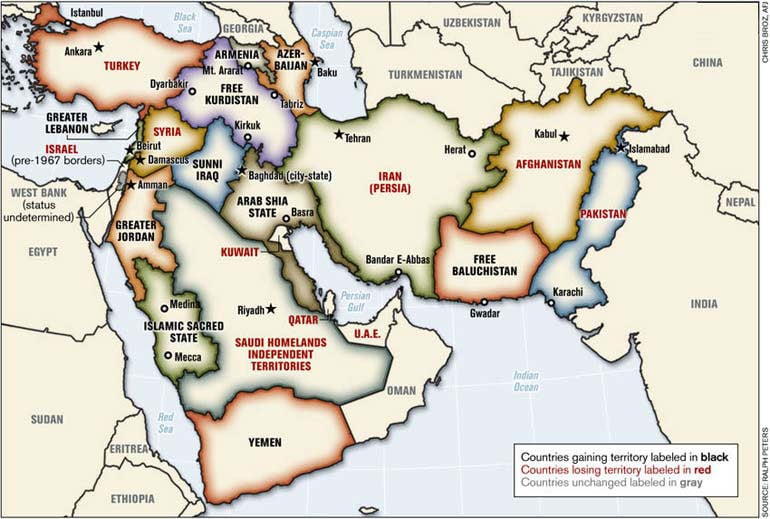
In the Middle East, the redrawing of political borders is contemplated by US military planners.
MAP OF THE NEW MIDDLE EAST

Note: The following map was prepared by Lieutenant-Colonel Ralph Peters. It was published in the Armed Forces Journal in June 2006, Peters is a retired colonel of the U.S. National War Academy. (Map Copyright Lieutenant-Colonel Ralph Peters 2006).
Although the map does not officially reflect Pentagon doctrine, it has been used in a training program at NATO’s Defense College for senior military officers. This map, as well as other similar maps, has most probably been used at the National War Academy as well as in military planning circles.
The War on Iran: World War III Scenario
As part of the Global War on Terrorism, the launching of an outright war using nuclear warheads against Iran – which has the world’s third largest known reserves of oil behind Saudi Arabia and Iraq – has been on the drawing board of the Pentagon since 2005. These plans are part of a broader Middle East Central Asian military agenda.
War on Iran is part of the Battle for Oil. Already during the Clinton administration, US Central Command (USCENTCOM) had formulated “in war theater plans” to invade both Iraq and Iran:
“…the President’s National Security Strategy (NSS) and the Chairman’s National Military Strategy (NMS) form the foundation of the United States Central Command’s theater strategy. The NSS directs implementation of a strategy of dual containment of the rogue states of Iraq and Iran as long as those states pose a threat to U.S. interests, to other states in the region, and to their own citizens. … The purpose of U.S. engagement, as espoused in the NSS, is to protect the United States’ vital interest in the region – uninterrupted, secure U.S./Allied access to Gulf oil. (USCENTCOM, http://www.milnet.com/milnet/pentagon/centcom/chap1/stratgic.htm#USPolicy , emphasis added)
Public opinion remains largely unaware of the grave implications of these war plans, which contemplate the use of nuclear weapons, ironically in retaliation to Iran’s non-existent nuclear weapons program.
Moreover, 21st Century military technology combines an array of sophisticated weapons systems whose destructive power would overshadow the nuclear holocausts of Hiroshima and Nagasaki. Lest we forget, the United States is the only country to have used nuclear weapons against civilians.
If such a war were to be launched, the entire Middle East/Central Asia region would be drawn into a conflagration. Humanity would be precipitated into a World War III scenario.
The danger of World War III is not front-page news. The mainstream media has excluded in-depth analysis and debate on the implications of these war plans.
 NATO’s “Humanitarian Intervention” Mandate defined in an ICISS report on R2P (ight0
The Anti-war Movement in Crisis: Cooptation and “Manufactured Dissent”
The antiwar movement in several Western countries is in crisis, dominated by self-proclaimed progressives. Some of America’s wars are condemned outright, while others are heralded as “humanitarian interventions”. A significant segment of the US antiwar movement condemns the war but endorses the campaign against international terrorism, which constitutes the backbone of US military doctrine.
Historically, progressive social movements (including the World Social Forum) have been infiltrated, their leaders co-opted and manipulated, through the corporate funding of non-governmental organizations, trade unions and political parties. The ultimate purpose of “funding dissent” is to prevent the protest movement from challenging the legitimacy of the capitalist elites.
The “Just War” theory (Jus Ad Bellum) has served to camouflage the nature of US foreign policy, while providing a human face to the invaders.
A large segment of “progressive” opinion in the US and Western Europe is supportive of NATO’s R2P “humanitarian” mandate to the extent that these war plans are being carried out with the “rubber stamp” of civil society. Prominent “progressive” authors as well independent media outlets have supported regime change and NATO sponsored humanitarian intervention in Libya. Similarly, these same self proclaimed progressives have rallied in support of the US-NATO sponsored opposition in Syria.
Let us be under no illusions: This pseudo-progressive discourse is an instrument of propaganda. Several prominent “left” intellectuals –who claim to be opposed to US imperialism– have supported the imposition of “no fly zones” and “humanitarian interventions” against sovereign countries.
“Progressives” are funded and co-opted by elite foundations including Ford, Rockefeller, et al. The corporate elites have sought to fragment the people’s movement into a vast “do it yourself” mosaic. War and globalization are no longer in the forefront of civil society activism. Activism tends to be piecemeal. There is no integrated anti-globalization anti-war movement. The economic crisis is not seen as having a relationship to the US led war.
Dissent has been compartmentalized. Separate “issue oriented” protest movements (e.g. environment, anti-globalization, peace, women’s rights, climate change) are encouraged and generously funded as opposed to a cohesive mass movement. This mosaic was already prevalent in the counter G7 summits and People’s Summits of the 1990s.
The “Revolution Business”
The imperial World Order creates its own opposition.
The Occupy movement in the US is infiltrated and manipulated.
“Colored Revolutions” financed by Wall Street unfold in different countries (e.g. Egypt, Ukraine, Georgia, Thailand, ). The CIA through various front organizations has infiltrated mass movements in different parts of the World.
The Centre for Applied Non Violent Action and Strategies (CANVAS), for instance, under the auspices of Serbia’s OTPOR is a CIA sponsored entity which describes itself as “an International network of trainers and consultants” involved in the “Revolution Business”.
Funded by the National Endowment for Democracy (NED), it constitutes a consulting outfit, advising and training US sponsored opposition groups in more than 40 countries. Its clench fist logo has been adopted by numerous “revolutionary” groups.


In turn, a panoply of alternative media upholds the “Colored Revolutions” as constituting a “Great Awakening”, a mass movement directed against the very foundations of the capitalist World order.
 In Egypt, for instance, several organizations involved in the Arab Spring including Kifaya and the April 6 Student movement were directly supported by US foundations and the US embassy in Cairo. In a bitter irony, Washington was supporting the Mubarak dictatorship, including its atrocities, while also backing and financing its detractors, through the activities of Freedom House (FH) and the National Endowment for Democracy (NED). Both of these foundations have links to the US State Department and the US Congress.
Under the auspices of Freedom House, Egyptian dissidents and opponents of Hosni Mubarak had been received in May 2008 by Condoleezza Rice at the State Department and the US Congress. The Egyptian pro-democracy delegation to the State Department was described by Condoleezza Rice as “The Hope for the Future of Egypt”. In May 2009, Hillary Clinton met a delegation of Egyptian dissidents (see image below), several of which had met Condoleezza Rice a year earlier.
9/11 Truth
In numerous organizations including the trade union movement, the grassroots is betrayed by their leaders who are co-opted. The money trickles down from the corporate foundations, setting constraints on grassroots actions. Its called “manufacturing dissent”. Many of these NGO leaders are committed and well meaning individuals acting within a framework which sets the boundaries of dissent. The leaders of these movements are often co-opted, without even realizing that as a result of corporate funding their hands are tied.
In recent history, with the exception of Iraq, the so-called Western left namely “Progressives” have paid lip service to US-NATO military interventions in Yugoslavia, Afghanistan, Libya and Syria. “Progressives” also support the official 9/11 version of events. They deny 9/11 Truth.
“Progressives” acknowledge that the US was under attack on 9/11 and that the war on Afghanistan was a “Just War”. In the case of Afghanistan, the “self-defense” argument was accepted at face value as a legitimate response to the 9/11 attacks, without examining the fact that the US administration had not only supported the “Islamic terror network”, it was also instrumental in the installation of the Taliban government in 1995-96. It was tacitly implied that by supporting al Qaeda, Afghanistan had attacked America on September 11, 2001.
In 2001, when Afghanistan was bombed and later invaded, “progressives” largely upheld the administration’s “just cause” military doctrine. In the wake of 9/11, the antiwar movement against the illegal invasion of Afghanistan was isolated. The trade unions and civil society organizations had swallowed the media lies and government propaganda. They had accepted a war of retribution against Al Qaeda and the Taliban. Several prominent “left leaning” intellectuals upheld the “war on terrorism” agenda.
Media disinformation prevailed. People were misled as to the nature and objectives underlying the invasion of Afghanistan. Osama bin Laden and the Taliban were identified as the prime suspects of the 9/11 attacks, without a shred of evidence and without addressing the historical relationship between Al Qaeda and the US intelligence apparatus. In this regard, understanding 9/11 is crucial in formulating a consistent antiwar position. 9/11 is the pillar of US war propaganda; it sustains the illusion of an outside enemy, it justifies pre-emptive military intervention.
The logic pertaining to Syria was somewhat different. “Progressives” and mainstream “antiwar” organizations have supported so-called opposition forces without acknowledging that the mainstay of these forces is composed of Al Qaeda affiliated terrorists, recruited, trained and financed by US-NATO and their allies including Israel, Turkey, Qatar and Saudi Arabia. These antiwar groups, which previously supported NATO intervention in Libya, blame the Syrian government for the atrocities committed by the US sponsored Al Qaeda rebels.
Rebuilding the Antiwar Movement
What is required is to rebuild a mass movement. And this cannot be led and manipulated by self-proclaimed “progressives” with the financial support of corporate foundations.
The social base as well as the organizational structure of the antiwar movement must be transformed. America’s “Long War” is an imperialist project which sustains the financial structures and institutional foundations of the capitalist World Order. Behind this military agenda are powerful corporate interests including an extensive propaganda apparatus.
War and the Economic Crisis are intimately related. The Worldwide imposition of neoliberal macro-economic policy measures is part of the broader imperial agenda. And consequently, the broader movement against neoliberalism must be integrated into the anti-war movement.
Breaking the “Big Lie” which presents war as a humanitarian undertaking, means breaking a criminal project of global destruction, in which the quest for profit is the overriding force. This profit-driven military agenda destroys human values and transforms people into unconscious zombies.
The holding of mass demonstrations and antiwar protests is not enough. What is required is the development of a broad and well-organized grassroots antiwar network, across the land, nationally and internationally, which challenges the structures of power and authority as well as the nature of the capitalist World order. People must mobilize not only against the military agenda – the authority of the state and its officials must also be challenged.
A meaningful anti-war movement requires breaking the “war on terrorism” consensus and upholding 9/11 Truth. To reverse the tide of war and globalization requires a massive campaign of networking and outreach to inform people across the land, nationally and internationally, in neighborhoods, workplaces, parishes, schools, universities and municipalities, on the nature the imperial project, its military and economic dimensions, not to mention the dangers of a US sponsored nuclear war. This movement must also occur within the Armed Forces (including NATO) with a view to challenging the legitimacy of the military agenda.
The message should be loud and clear:
The US and its allies are behind the Al Qaeda terrorists who have committed countless atrocities against civilians on the specific instructions of the Western military alliance,
Neither Syria nor Iran are a threat to World Peace. Quite the opposite. The threat emanates from the US and its allies. Even in the case of a conventional war (without the use of nukes) , the proposed aerial bombardments directed against Iran could result in escalation, ultimately leading us into a broader war in the Middle East.
What has to be achieved:
Reveal the criminal nature of this military project.
Break once and for all the lies and falsehoods which sustain a “political consensus” in favor of a pre-emptive nuclear attack on Iran.
Undermine war propaganda, reveal the media lies, reverse the tide of disinformation, wage a consistent campaign against the corporate media.
Break the legitimacy of the warmongers in high office. Indict political leaders for war crimes.
Dismantle the multibillion dollar national intelligence apparatus.
Dismantle the US-sponsored military adventure and its corporate sponsors.
Bring home the troops.
Repeal the illusion that the state is committed to protecting its citizens.
Uphold 9/11 Truth. Reveal the falsehoods behind 9/11 which are used to justify the Middle East/Central Asian war under the banner of the “Global War on Terrorism” (GWOT).
Expose how a profit-driven war serves the vested interests of the banks, the defense contractors, the oil giants, the media giants and the biotech conglomerates.
Challenge the corporate media which deliberately obfuscates the causes and consequences of this war.
Reveal and take cognizance of the unspoken and tragic outcome of a war waged with nuclear weapons.
Call for the Dismantling of NATO.
Reorganize the system of international justice which protects the war criminals. Implement the prosecution of war criminals in high office.
Close down the weapons assembly plants and implement the foreclosure of major weapons producers.
Close down all US military bases in the US and around the world.
Develop an antiwar movement within the armed forces and establish bridges between the armed forces and the civilian antiwar movement.
Forcefully pressure governments of both NATO and non-NATO countries to withdraw from the US-led global military agenda.
Develop a consistent antiwar movement in Israel. Inform the citizens of Israel of the likely consequences of a US-NATO-Israeli attack on Iran.
Target the pro-war lobby groups including the pro-Israeli groups in the US.
Dismantle the homeland security state. Repeal the legitimacy of Obama’s extrajudicial assassinations. Repeal the drone wars directed against civilians.
Undermine the “militarization of law enforcement”. Reverse the gamut of anti-terrorist legislation in Western countries which is intended to repeal fundamental civil rights.
These are no easy tasks. They require an understanding of the power structure, of hegemonic relations between the military, intelligence, the state structures and corporate powers which are promoting this destructive agenda. Ultimately these power relations must be undermined with a view to changing the course of World history.
Michel Chossudovsky is an award-winning author, Professor of Economics (emeritus) at the University of Ottawa. He is the Founder and Director of the Centre for Research on Globalization (CRG), Montreal and Editor of the globalresearch.ca website. He is the author of The Globalization of Poverty and The New World Order (2003) and America’s “War on Terrorism”(2005). His most recent book is entitled Towards a World War III Scenario: The Dangers of Nuclear War (2011). He has taught as Visiting Professor at universities in Western Europe, South East Asia and Latin America, acted as an adviser to governments of developing countries and as a consultant for several international organizations.
Prof. Chossudovsky is a member of the Kuala Lumpur War Crimes Commission (KLWCC) which led the 2013 legal procedure against the State of Israel on genocide charges. He is recipient of the Human Rights Prize of the Society for the Protection of Civil Rights and Human Dignity (GBM), Berlin, Germany. He is also a contributor to the Encyclopaedia Britannica. His writings have been published in more than twenty languages.


 Par Evens Dubois
  Une petite anecdote. Lors des funérailles du très regretté Père Gérard Jean Juste, l’ancienne sénatrice Mirlande Luberice regardait Oriel Jean avec une véritable répulsion. Les gens présents pensaient qu’elle allait vomir. L’ancien chef de sécurité du président Aristide s’emporta en déclarant : ”Say genyen w ap gade m konsa? Se pou m te bay yon vyann pou jwenn byen m yo! " Oriel Jean ferait n’importe quoi pour parvenir a ses fins. C’est un individu sans scrupules, borné et teigneux. Après s’être échappé lors du coup d’état du 29 février 2004, il s’était fait coincer dans un aéroport au Canada avec la fabuleuse somme de 300.000 dollars américains et d’un cheque d’un montant de 17.000 américains. Car, il pensait qu’une fois la débâcle consommée, il allait refaire sa vie la bas. Mais c’était bien compté, mal calculé. Le gouvernement canadien l’expédia comme un mauvais colis aux États Unis puisque recherché par la Drug Enfoncement Agency (DEA). Il a été condamné à de très Lourdes peines aussi il avait obtenu une réduction de peine de quatre à cinq ans en vendant ses amis. Il a même été admis sur la liste de «témoins sous protection”. Il témoigna contre son ancien patron Sergo Persévérance dans le trafic de la drogue lors de son procès à Miami. Ce dernier est un ancien tenancier de borlette. Rudy Terrassant, l’ancien commandant de la BRI, a été coincé grâce à Oriel Jean. Ces deux individus sont les seuls à avoir reçu de Lourdes peines de prison et continuent à les purger. Une fois libéré, Oriel Jean ne s’arrêtera pas en si bon chemin. Preuve qu’il avait bien joué son rôle d’informateur et de dénonciateur : il était employé au sein du service de sécurité de l’aéroport international de Fort Lauderdale. Son job : aider à filtrer les passagers sur les vols en provenance d’Haïti. Cela avait provoqué un certain malaise dans la communauté haïtienne. Il n’avait pas les qualités requises, entre autres la citoyenneté américaine, pour occuper un tel poste. Il était devenu une espèce de pestiféré aux yeux de plus d’un. Ou du moins ceux qui connaissent son passé.
 Haitian President Michel Martelly