Tuesday, February 4, 2014

HAITI: UN PARADIS POUR LES ASSASSINS (1ere partie)

Un paradis pour les assassins (Première partie)

  • Imprimer
evinks-daniel-sourireEvinks Daniel ami personnel de Michel Martelly porté disparuPar Leslie Péan, 3 février 2014 ---  Le vendredi 9 novembre 2012, un commando de quatre hommes lourdement armés et encagoulés a abattu l’inspecteur divisionnaire Yves Michel Bellefleur au carrefour Gérald Bataille (banlieue nord de Port-au-Prince) à Delmas 33. Les assassins circulaient dans une voiture avec des vitres teintées et une plaque d’immatriculation «  Service de l’État ». Le même jour, quelques heures plus tard, un deuxième policier, Johnny Mathieu, a aussi été froidement abattu de quatre balles par un commando au boulevard Jean-Jacques Dessalines, près du portail Saint-Joseph. Les séquences de la mort n’ont cessé de tuer, de ravager les corps et les esprits. Fini le temps de la sérénité. Les épines de la violence ont attaqué notre pensée pour nous forcer à consentir à ses règles et à rester silencieux comme des zombies.
Le rapport du Réseau national de défense des droits humains (RNDDH) fait état de plus de 1.000 morts violentes en Haïti pour la période mai 2012-mai 2013. L’horreur est devenue une fatalité. Comme une onde de choc, elle avance crescendo terrassant autant des étrangers que des Haïtiens. Dans l’agora, on se questionne sur cette malédiction. Naïveté ? Irresponsabilité ? Le dispositif monstrueux qui nous fait chanter des requiem a atteint son seuil de maturation. Garder la sérénité devant l’aberration qui suicide la société haïtienne n’empêche l’épanouissement du carnage. Et nombre de ceux qui avaient pourtant flairé le danger sous le gouvernement Martelly ont été éliminés par l’acharnement du vent de folie. C’est le cas avec Guiteau Toussaint le 12 juin 2011 ; Manès Monchéry et sa famille, Damaël D’Haïti, Jean-Philippe Jean Baptiste alias Samba Boukman, Serge Bernard, Edouard Moscoso en 2012 ; Georges Honorat et le juge Jean Serge Joseph en 2013.
L’engrenage de la violence n’a jamais cessé depuis la fuite des Duvalier en 1986. La victoire du courant populaire aux élections du 16 décembre 1990 va même déclencher le renouveau de l’extrême droite duvaliériste. Le tenant de la ligne dure des macoutes, Roger Lafontant, tentera un soulèvement dans la nuit du 6 au 7 janvier 1991, avant même la prestation de serment du nouveau pouvoir. Sa tentative se solde par un échec toutefois prémonitoire, débouchant sur le coup d’État du 30 septembre 1991. L’action répressive des militaires s’abat non seulement sur des personnalités connues telles que Guy Malary, Ministre de la Justice ; Antoine Izméry, l’homme d’affaires ; Jean-Marie Vincent, prêtre ; mais aussi sur les militants anonymes du camp Lavalasse. Selon Jean-Philippe Belleau[1], « Le nombre total de victimes de ce régime militaire, qui dure trois années, varie de 10 000 à 30 000. » C’est le désenchantement total. Les massacres de Raboteau[2], un quartier populeux des Gonaïves, du 2 octobre 1991 et du 22 avril 1994, sont symptomatiques d’une période où les obsédés du pouvoir sèment la mort en toute impunité.
Le camp des assassins calcule ses coups. Aristide a avalé son chapeau et est revenu dans les fourgons des militaires américains en 1994. Il se veut un enfant sage injustement puni. Les coups bas reçus par l’économie haïtienne en échange de son retour au pouvoir ont cassé le momentum de la tentative de constitution d’un État populaire et démocratique. Mais c’était la condition posée par les Américains pour son retour. La recherche du pouvoir à tout prix fait germer une abominable politique de cauchemar avec toutes sortes de caricatures et de cadavres qui sortent des tombeaux. Aristide joue la montre. Devant le refus des Américains de lui permettre de prolonger son mandat de trois ans (pour compenser les trois années d’exil), il s’arrange pour passer le pouvoir à René Préval. Il n’empêche que les assassins ne démordent pas pour qu’Haïti reste un département de l’enfer.
L’Organisation Politique Lavalas (OPL) appuie le candidat René Préval qui gagne les élections avec 87% des suffrages, tout en remportant 17 des 27 sièges au Sénat et 66 des 83 à la Chambre des Députés. Un vrai raz-de-marée ! Mais la folie des sommets se mue vite en perdition, surtout après les élections de 1995 considérées frauduleuses par tous les observateurs internationaux. On n’avait jamais vu rien de pareil dans les chroniques de la trahison. Stratège autoproclamé et habile pêcheur en eau trouble, René Préval est également allergique aux institutions, partis politiques et organes de l’État confondus. C’est ainsi qu’il va piéger dès 1996 l’OPL de Gérard Pierre-Charles et disloquer le Parlement, tout en semblant accepter de bon gré les diktats venant de Tabarre.
Comme à l’époque de Samarcande dans l’ancienne Perse d’Hassan Sabbah, la mort continue d’être semée avec une « remarquable capacité de caméléonage »[3] dans une Haïti qui devient un paradis pour les brigands et les assassins. La mort fauche à tort et à travers. Dans la dérive qui a ôté dans un premier temps la vie à l’avocate Mireille Durocher Bertin, à l’homme d’affaires Michel Gonzalès, au colonel Max Mayard et au député Yvon Feuillé, Haïti patauge avec enthousiasme dans la mort. Les assassins ne s’attaquent pas uniquement à l’opposition. Le lendemain de l’annonce par le président Préval de son intention de gouverner par décret[4], les luttes de clans font rage au sein même du pouvoir au point où l’ex-colonel Jean Lamy[5], proche conseiller du président de la République, est assassiné, tandis que la sœur de président, Marie-Claude Préval Calvin, est blessée de trois balles et que son chauffeur est tué. Les assassins n’attaquent pas seulement les personnes. Ils s’en prennent aussi aux animaux comme ce fut le cas avec le caniche de l’épouse du président, Mme Jerry Benoit Préval, abattu dans l’enceinte même du Palais national. La méchanceté et la terreur s’étalent dans leurs aspects les plus sordides.
Ironie des choses : la cruauté qui s’est installée avec force et perversité sous le gouvernement Préval est racontée par nul autre que l’ex-général Prosper Avril, président de 1988 à 1990. Un coutumier de l’horreur duvaliériste qui a œuvré au cœur de ce régime d’éteignoir et qui a dirigé, selon le mot de Paul Farmer, « la campagne d’assassinat contre les partisans d’Aristide »[6]. La répétition du malheur d’autrui provoque de telles souffrances qu’Avril n’a pas pu s’esquiver. Les temps forts qui rythment cette insécurité sont l’assassinat du pasteur Antoine Leroy le 20 août 1996, celui de Micheline Coulanges le 22 décembre 1997, celui du prêtre Jean Pierre-Louis le 3 août 1998, ceux du militaire Jean Lamy et du sénateur Yvon Toussaint en 1999, celui du journaliste Jean Dominique et de Jean-Claude Louissaint le 3 avril 2000 et enfin celui du docteur Ary Bordes le 6 mai 2000.

Le meurtre d’une figure légendaire

 Le meurtre du siècle est celui du journaliste agronome Jean Léopold Dominique le 3 avril 2000. « Les assassins sont dans la ville » disait-il souvent. C’est aussi ce qui est écrit sur l’affiche avec la photo de Jean Dominique appelant à trouver et punir les auteurs de ce crime crapuleux. Plus que jamais, ce meurtre au lever du soleil indique que « l’Haïti chérie » martelée par l’idéologie n’existe plus avec cette série noire des assassinats politiques. Les assassins déroulent leur tapis de mort sans aucune inquiétude sachant que la société haïtienne est impuissante devant les loups-garous et autres bandits qui sèment la mort, conscients qu’ils vont toujours bénéficier de l’impunité. En dépit du fait qu’aucune inculpation n’a été prononcée, les dégâts sont considérables. Les supputations les plus fantaisistes sont évoquées pour expliquer ce crime.
Certains prétendent que les commanditaires pensaient que Jean L. Dominique allait se présenter aux élections à la présidence. Niant que son mari ait jamais eu de telles aspirations, son épouse Michèle Montas explique que son mari voulait tout simplement à libérer ses compatriotes de la peur. En réalité, il s’agit d’un meurtre pour faire peur d’abord aux journalistes. Mais surtout pour transformer en zombies tous les Haïtiens afin qu’ils n’osent dire la vérité sur la situation macabre et infernale d’Haïti en les menaçant de les emporter dans l’au-delà. Derrière son micro, Jean Dominique combattait les vieilles idées. Il avait des correspondants à travers le pays et particulièrement dans la paysannerie qui sera pour lui une véritable mine, mettant ainsi à profit la documentation de base acquise au cours d’une décennie de travail comme agronome dans les plantations de café, de cacao et de pite de Bayeux dans le Nord d’Haïti.
Ses reportages sur la corruption publique, les détournements de l’aide étrangère, le calvaire des boat-peole de Cayo Lobos, etc. ont fait grincer des dents. Sa couverture d’événements tels que le renversement du dictateur Somoza au Nicaragua, les élections présidentielles américaines, ses entrevues avec des personnalités telles que Michael Manley, François Mitterrand, André Malraux, Leopold Sedar Senghor, Charles Aznavour, etc. tombaient comme une manne pour son public. Dans ses éditoriaux, il sortait des sentiers battus et on le craignait. Surtout ceux qui voulaient faire carrière politique avec les mêmes valeurs des adversaires qu’ils aspiraient à remplacer. À un moment où les autres stations de radio offraient leurs programmes de nouvelles en français uniquement, son travail de promotion du créole à Radio Haïti Inter[7]constitue une étape importante de la quête d’haïtianité.
Jean Dominique avait un capital de popularité bien réelle qui pouvait être converti à tout moment sur le terrain électoral. Sa réception par 60 000 personnes à son retour d’exil en 1986 est la moindre des démonstrations de cette popularité. Il venait remettre dans l’air son entreprise Radio Haïti Inter qu’il avait démarré en 1968 et qui était devenue à sa fermeture en 1980 la station la plus écoutée du pays. Avec une audience de plus de 2 millions de personnes et un personnel de 45 professionnels aux semelles de vent répartis à travers le pays, Radio Haïti Inter donnait un nouvel éclairage tous les jours en lever de rideau. C’était le rendez-vous quotidien de tous les amoureux de la liberté qui voulaient bousculer l’ordre dictatorial et anti-populaire qui sévit en Haïti. Jean Do a pu mettre en place cette institution malgré les embûches.
Comme il l’explique lui-même : « Nous avions refusé les subventions officielles ou discrètes qui lient traditionnellement le gouvernement et les médias. Notre budget de fonctionnement relevait totalement de publicités commerciales. En 1979, les gros clients Brandt, Madsen, Mevs, Dadesky, Mourra, mirent fin à leurs achats publicitaires, pour plaire au pouvoir[8]. » Malgré ces péripéties, Radio Haïti Inter était tout compte fait positif et pas uniquement sur le plan financier. Grâce à ses talents d’administrateurs, Jean Do a pu quintupler son chiffre d’affaires entre 1968 et 1980.
Sur le bûcher qui va le consumer, Giordano Bruno avait dit : « Plus on est intelligent, plus on est couillonné ». Jean Dominique aurait pu dire la même chose au tueur à gages braquant un canon de revolver sur sa tempe. Il n’a pas cédé à l’inquisition haïtienne, et sa mort ne saurait constituer une rédemption pour ses meurtriers. La pensée de cet homme qui a bravé tous les dangers s’exprime surtout dans les chasses interdites qu’il a menées sur le terrain de l’idéologie haïtienne. Son souci de vérité est sans complaisance. À cet effet, en 1983, il m’écrira les mots suivants :
« Non, non et non, on nous cache à nouveau les choses, on veut détourner notre regard d’un mal profond, fondamental, je dis bien fondamental de notre sous-développement, appelons-le aujourd’hui non la question de couleur, ni le problème de couleur, mais la pratique du colorisme. C’est là-dessus qu’il faut engager le débat. Pourquoi ? Parce que le fait évident de la nouvelle situation haïtienne est le retour en force du mulâtrisme une fois de plus imbécile, pillard, valet des compradores et, par dessus le marché, laquais de la bourgeoisie raciste dominicaine. Le projet mulâtriste des années 80 se trouve ainsi renforcé par un allié de taille, et celui-ci intelligent, de l’oligarchie de Santiago partie à la conquête du marché haïtien et imprégné idéologiquement de l’esprit de revanche (enfin l’heure de laver l’affront de Boyer est arrivée pour eux)[9]. »
En clair, Jean Dominique devançait une réalité prédéterminée dans les rapports haïtiano-dominicains. Prémonitoire. Surtout quand tout démarre à partir d’un projet politique orchestré autour de l’incitation à la débauche de l’équipe Tèt Kale. Aujourd’hui que ces bonnes mœurs n’ont plus besoin de l’obscurité de la nuit e s’affichent en plein jour, Jean Dominique n’aurait pas esquivé le sujet. Il s’était inscrit dans la lutte contre ce qui semble être une fatalité. Un peu comme l’écrivain péruvien Manuel Scorza l’a fait dans Le tombeau de l’éclair[10]. Il aurait dénoncé avec sa fougue habituelle les délices des contrats délictueux entre les firmes dominicaines et le gouvernement Martelly. Jean Dominique se serait inscrit en contrepoint des positions de ce gouvernement de Skin Heads (Tèt Kale).
Il serait monté à l’assaut pour montrer ce que l’équipe Martelly a derrière la tête en encaissant sans broncher le coup de l’arrêt TC 168-13 du Tribunal Constitutionnel dominicain. Il aurait surtout montré le vrai visage de l’équipe Martelly qui engage un dialogue bilatéral avec le gouvernement dominicain au lieu d’appuyer l’offensive multilatérale menée contre les ambitions racistes des extrémistes dominicains qui veulent néantifier les Dominicains d’origine haïtienne. En demandant à la Caricom de se retirer du dossier, le gouvernement Martelly appuie la République Dominicaine qui fait « des démarches auprès de l'opinion publique internationale, y compris l'OEA, visant à faire croire que le problème épineux créé par l'arrêt TC 168-13 était pratiquement résolu, grâce à ce dialogue bilatéral[11]. »
Partisan de Lavalas, Jean Dominique secouait le cocotier au risque que le tronc se casse. Il n’était pas du genre à accepter que tout reste désespérément semblable malgré les changements de gouvernement. Il a été abattu à bout portant par un assassin en mission commandée. C’est dans la même logique que son épouse Michèle Montas devait être également agressée le 25 décembre 2002. Elle eut la vie sauve miraculeusement mais son garde du corps Maxime Séide a été assassiné. Face à d’autres menaces et agressions subies par des journalistes de la station, Michèle Montas et Gigi Dominique, la fille de Jean Dominique, qui assuraient la gestion de Radio Haïti Inter furent contraintes d’éteindre les émetteurs le 21 février 2003 et de laisser le pays[12]. Toutefois, le visage mythique de Jean Dominique demeure comme fondateur d’une œuvre qui continue avec Marcus Garcia, Sony Bastien, Marvel Dandin, Liliane Pierre-Paul, Konpè Filo, etc. Jean Dominique est passé comme un météore, mais son influence non seulement dans le journalisme mais aussi dans l’ensemble de la société.
Le fait que le meurtre de cette figure légendaire n’ait pas été élucidé depuis plus une décennie est indicateur de la puissance des forces agissantes derrière cette expédition meurtrière et criminelle. L’enquête piétine et les commanditaires de ce crime n’ont pas été arrêté et punis. L’absence de poursuite à charge des coupables laisse supposer que les commanditaires sont haut placés dans la hiérarchie politique du pays. Depuis l’assassinat de Jean Dominique, « neuf juges d’instruction ont travaillé sur l’affaire sans faire toute la lumière sur les tueries »[13]. Qu’il ait fallu attendre 14 ans pour que finalement neuf inculpés soient déférés devant les tribunaux prouve l’état de délabrement de la justice en Haïti. Une situation de passivité incompréhensible, injustifiable et qui montre la complicité dont bénéficient les forces du mal dans ce pays.

 Le pouvoir fait perdre son innocence au mouvement démocratique

 L’apocalypse se répète sous le ciel d’Haïti. En fin connaisseur des assassinats commis sous le duvaliérisme, Prosper Avril ne fait pas le mort et présente le décompte des victimes. Il raconte leurs misères dans son ouvrage « Haïti (1995-2000) – le livre noir de l’insécurité »[14]. Prosper Avril identifie plus d’un millier d’individus assassinés au cours de ces années d’enfer. Si dans les heures les plus sombres de la dictature dans l’histoire d’Haïti, ce sont les journalistes et les avocats qui paient le tribut le plus lourd, c’est alors le corps médical qui passe à la caisse avec les assassinats des confrères Lowinsky Sévère, Wilfrid Figaro, Maryse Plaisimond, Fritz Jocelyn, Anne-Marie Guirand, Ary Bordes. Abstraction faite des 50 000 victimes des 29 ans du duvaliérisme, on peut dire que le terrorisme d’État est rarement allé aussi loin dans la honte et le dégoût de soi, avec ses quatre grands assassinats par semaine sur la période de cinq ans comprise entre 1996 et 2000.
Aristide sauve ce qu’il peut et revient au pouvoir en 2001. Mais il n’est plus, pour l’heure, en situation d’aider le pays. Pas comme il l’était en décembre 1990. La coalition avec l’OPL, devenue Organisation du Peuple en Lutte, et le KONAKOM a sauté après les élections législatives et locales frauduleuses d’avril 1997. Cette propension à la fraude électorale se renouvelle aux élections législatives et sénatoriales du 19 mars et du 30 avril 2000. Dès le premier tour, le pouvoir recourt à la tricherie dans ses méthodes d’utilisation de bulletins blancs, de dépouillement des votes et d'attribution des sièges. La falsification est documentée par l’Organisation des États Américains (OEA) et plus de 200 observateurs internationaux[15]. Alors, la Convergence Démocratique (CD) regroupant les principaux partis de l’opposition (OPL, ESPACE DE CONCERTATION, MOCHRENA, MPSN, PADEMH et RDNP) dénonce les résultats des élections du 26 novembre 2000 et appelle à la création d’un gouvernement provisoire de consensus et d’unité nationale. (à suivre)
Leslie Péan
Economiste, Historien

[1] Jean-Philippe Belleau, « Massacres perpetrated in the 20th Century in Haiti », Online Encyclopedia of Mass Violence, 2 April 2008.
[2] Gilles Danroc et Daniel Roussière, La Répression au quotidien en Haïti (1991-1994), Karthala, 1995. Lire aussi Gilles Danroc et Daniel Roussière, « Soif de justice en Haïti », Le Monde Diplomatique, mai 1998. Lire enfin « Plainte de Marie Jeanne Jean dont le mari a été tué le 22 avril 1994 à Raboteau », Tribunal de Première Instance des Gonaïves, Gonaïves, 29 octobre 1996.
[3] Amin Maalouf, Samarcande, Paris, Jean-Claude Lattès, 1988, p. 125.
[4] « Haiti Leader to Rule by Decree; an Attack Follows », New York Times, January 13, 1999.
[5] Edouard Archer, Au rythme trépidant des jours, Presses de l'Imprimeur II, 1998-2000, p. 512-513.
[6] Paul Farmer, « Who removed Aristide? », London Review of Books, Vol. 26 No. 8. 15 April 2004, pages 28–31
[7] Jean Léopold Dominique, « Une quête d'haïtianité – Collier maldioc et transitor », Conjonction, no 129, 1976.
[8] Jean Léopold Dominique, « La presse indépendante et la contestation populaire – Le cas de Radio Haiti Inter », Haiti-Demain, vol. 1, No. 9, New-York, 1983, p. 22.
[9] Jean Dominique, « Quelques notes sur " l’âge de la bourgeoisie en Haïti " de Leslie Péan, Inédit, 1983, p. 3.
[10] Manuel Scorza, Le tombeau de l’éclair, Paris, Belfond, 1984.
[11] Déclaration d’organisations de la société civile haïtienne [Groupe d'Appui aux Rapatriés et Réfugiés (GARR.); Service Jésuite aux Réfugiés et aux Migrants (SJRM) ; Collectif Haïtien sur les Migrations et le Développement (COHAMID) ; Fondation ZILE ; Comité Mémoire 1937] à la veille de la seconde ronde des conversations multilatérales sur le dossier haïtiano-dominicain, P-au-P, 22 janvier 2014.
[12] « Face à des menaces persistantes, Radio Haïti Inter éteint ses émetteurs », Alterpresse, 21 février 2003.
[13] Amnistie Internationale, Haïti : Jean Dominique : douze années d’impunité, 3 avril 2012.
[14] Prosper Avril, Haïti (1995-2000) – le livre noir de l’insécurité, Haïti, Imprimerie Le Natal, 2001.
[15] Organization of American States (OAS), AS, Electoral Observation in Haiti, Legislative, Municipal, and Local Elections February to July 2000, Electoral Observations in the Americas Series, No. 28, Washington, D.C., 2001.
 A Lire Aussi:

LES ETATS-UNIS, PREMIERS FINANCIERS MONDIAUX DU TERRORISME

Les États-Unis, premiers financiers mondiaux du terrorisme

Global Research, février 04, 2014
En violation des résolutions 1267 et 1373 du Conseil de sécurité, le Congrès des États-Unis a voté le financement et l’armement du Front al-Nosra et de l’Émirat islamique d’Irak et du Levant, deux organisations relevant d’Al-Qaïda et classées comme « terroristes » par les Nations Unies. Cette décision est valide jusqu’au 30 septembre 2014.
Depuis la guerre d’Afghanistan contre les Soviétiques, de nombreux auteurs ont mis en évidence le rôle des États-Unis dans le financement du terrorisme international. Cependant, jusqu’à aujourd’hui, il ne s’agissait que d’actions secrètes, jamais assumées sur le moment par Washington. Un pas décisif a été franchi avec la Syrie : le Congrès a voté le financement et l’armement de deux organisations représentant Al-Qaïda. Ce qui était jusque-là un secret de polichinelle devient désormais la politique officielle du « pays de la liberté » : le terrorisme.
La première semaine de la Conférence de paix de Genève 2 aura été pleine de rebondissements. Malheureusement, le public occidental n’en a pas été informé, victime de la censure qui l’opprime.
C’est en effet le principal paradoxe de cette guerre : les images sont l’inverse de la réalité. Selon les médias internationaux, le conflit oppose d’un côté, des États réunis autour de Washington et de Riyad qui prétendent défendre la démocratie et conduire la lutte mondiale contre le terrorisme, de l’autre la Syrie et ses alliés russes, inhibés à force d’être diffamés en dictatures manipulant le terrorisme.
Si tout le monde est conscient que l’Arabie saoudite n’est pas une démocratie, mais une monarchie absolue, la tyrannie d’une famille et d’une secte sur tout un peuple, les États-Unis ont l’image d’une démocratie et mieux encore du « pays de la liberté ».
Or, la principale information de la semaine a été censurée dans l’ensemble des États membres de l’Otan : le Congrès états-unien s’est réuni secrètement pour voter le financement et l’armement des « rebelles en Syrie » jusqu’au 30 septembre 2014. Vous avez bien lu. Le Congrès tient des séances secrètes dont la presse n’a pas le droit de faire mention. C’est pourquoi l’information, originellement publiée par l’agence britannique Reuters [1], a été scrupuleusement ignorée par toute la presse imprimée et audio-visuelle aux États-Unis et la plupart des médias en Europe occidentale et dans le Golfe. Seuls les habitants du « reste du monde » ont eu droit à connaître la vérité.
La liberté d’expression et le droit des citoyens à l’information sont pourtant des préalables à la démocratie. Ils sont mieux respectés en Syrie et en Russie qu’en Occident.
Personne n’ayant lu la loi adoptée par le Congrès, on ignore ce qu’elle stipule exactement. Cependant, il est clair que les « rebelles » en question ne cherchent pas à renverser l’État syrien —ils y ont renoncé—, mais à le « saigner ». C’est pourquoi, ils ne se comportent pas en soldats, mais en terroristes. Vous avez encore bien lu : les États-Unis, prétendument victimes d’Al-Qaïda le 11 septembre 2001 et depuis leaders de la « guerre globale au terrorisme », financent le principal foyer de terrorisme international où agissent deux organisations officiellement subordonnées à Al-Qaïda (le Front al-Nosra et l’Émirat islamique d’Irak et du Levant). Il ne s’agit plus là d’une manœuvre obscure des services secrets, mais d’une loi, pleinement assumée, même si elle a été adoptée à huis clos de manière à ne pas contredire la propagande.
D’un autre côté, on ne voit pas comment la presse occidentale, qui affirme depuis 13 ans qu’Al-Qaïda est l’auteur des attentats du 11-Septembre et ignore la destitution du président George W. Bush ce jour-là par les militaires, pourrait expliquer cette décision à son public. Effectivement, la procédure états-unienne de « Continuité du gouvernement » (CoG) est elle aussi protégée par la censure. De la sorte, les Occidentaux n’ont jamais su que, ce 11 septembre, le pouvoir avait été transféré des civils aux militaires, de 10h du matin jusqu’au soir, que durant cette journée les États-Unis avaient été gouvernés par une autorité secrète, en violation de leurs lois et de leur constitution.
Durant la Guerre froide, la CIA finançait l’écrivain George Orwell lorsqu’il imaginait la dictature du futur. Washington croyait ainsi éveiller les consciences au danger soviétique. Mais en réalité, jamais l’URSS ne ressembla au cauchemar de « 1984  », tandis que les États-Unis en sont devenus l’incarnation.
Le discours annuel de Barack Obama sur l’état de l’Union s’est ainsi transformé en un exceptionnel exercice de mensonge. Devant les 538 membres du Congrès l’applaudissant debout, le président a déclaré : « Une chose ne changera pas : notre détermination à ce que des terroristes ne lancent pas d’autres attaques contre notre pays ». Et encore : « En Syrie, nous soutiendrons l’opposition qui rejette le programme des réseaux terroristes ».
Pourtant, lorsque la délégation syrienne à Genève 2 a soumis à celle sensée représenter son « opposition » une motion, exclusivement basée sur les résolutions 1267 et 1373 du Conseil de sécurité, condamnant le terrorisme, celle-ci l’a rejetée sans provoquer la moindre protestation de Washington. Et pour cause : le terrorisme, c’est les États-Unis, et le délégation de l’« opposition » reçoit ses ordres directement de l’ambassadeur Robert S. Ford, présent sur place.
Robert S. Ford, l’ancien assistant de John Negroponte en Irak. Au début des années 80, Negroponte avait attaqué la révolution nicaraguayenne en engageant des milliers de mercenaires qui, mêlés à quelques collaborateurs locaux, constituèrent les « Contras ». La Cour internationale de Justice, c’est-à-dire le tribunal interne des Nations Unies, condamna Washington pour cette ingérence qui ne disait pas son nom. Puis, dans les années 2000, Negroponte et Ford rejouèrent le même scénario en Irak. Cette fois, il s’agissait d’anéantir la résistance nationaliste en la faisant combattre par Al-Qaïda.
Pendant que les Syriens et la délégation de l’« opposition » discutaient à Genève, à Washington, le président poursuivait son exercice d’hypocrisie et assénait au Congrès qui l’applaudissait mécaniquement : « On lutte contre le terrorisme non seulement à l’aide du renseignement et des opérations militaires, mais aussi en restant fidèles aux idéaux de notre Constitution et en donnant l’exemple au monde (…) Et nous continuerons à travailler avec la communauté internationale pour faire naître l’avenir que mérite le peuple syrien – un avenir sans dictature, sans terreur et sans peur ».
La guerre livrée par l’Otan et le CCG à la Syrie a déjà fait plus de 130 000 morts —selon les chiffres du MI6 diffusés par l’Observatoire syrien des Droits de l’homme—, dont les bourreaux attribuent la responsabilité au peuple qui ose leur résister et à son président, Bachar el-Assad.
Thierry Meyssan


GOOGLE'S " SMART HOME" SURVEILLANCE PLANS,OR, HOW NOT TO BE COLONIZED

Google’s “Smart Home” Surveillance Plans, or, How Not to be Colonized

Global Research, February 02, 2014
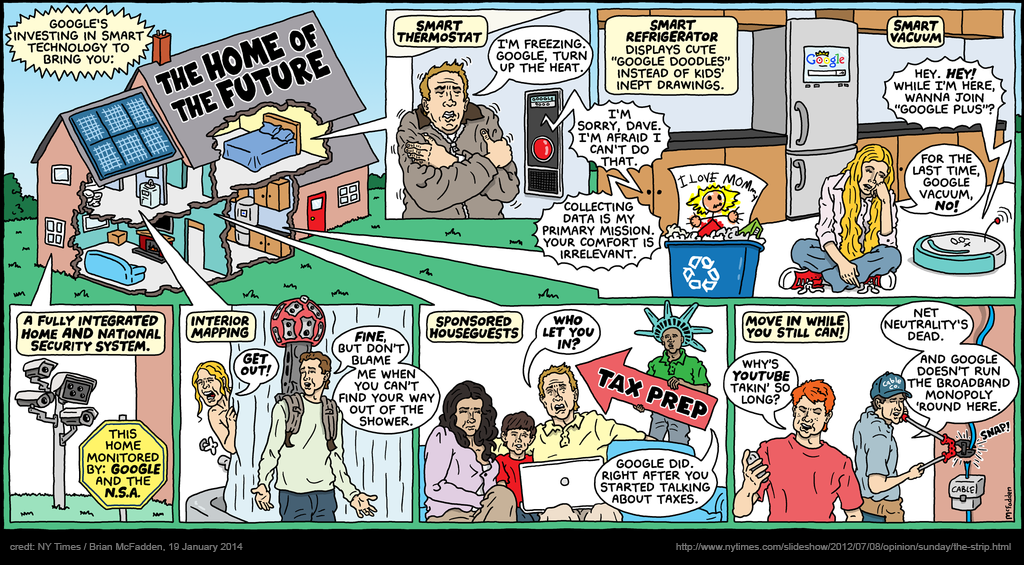
Two weeks ago, the New York Times’ truth-humor strip on “The Home of the Future” came on the heels of Google’s purchase of ‘smart thermostat’ manufacturer Nest for $3.2 Billion.
With power utility commissions such as California already stating their intention to “expand third-party access” to in-home data, the perfect storm is brewing for Google’s mission of making you their product – even in your own home.
Image: Copyright NYT, 2014
For context, this is the same Google whose executive chairman, Eric Schmidt, told MSNBC:
“If you have something that you don’t want anyone to know, maybe you shouldn’t be doing it in the first place.”
While pushing to nullify privacy laws, the Big G obviously doesn’t care about pesky old-fashioned incumbrances like ethics either, as evidenced by this gem:
“I would argue that [us] implanting things in your brain is beyond the creepy line – at least for the moment, until the technology gets better.”
The timing of Google’s purchase announcement is interesting, coming only a couple weeks after US federal judge William Pauley ruled that the unwarranted NSA phone surveillance against US citizens is legal. However, federal judge Richard Leon, the European Union, and the Privacy and Civil Liberties Oversight Board have all strongly condemned the spy programs. (The credibility of the Justice Department is in serious question, following revelations that last April it had secretly inked a deal with the Obama Administration to help corporations evade federal wiretap laws.)
The Battleground Hits Home
More than 1 million homeowners have refused the corporate push to install a ‘smart’ meter on their home.So where does a ‘smart thermostat’ fit in the current corporatist drive for total in-home surveillance?
For the last couple of years, utilities around the globe have all been touting their new metering systems with buzzwords such as ‘smart’, ‘advanced’, ‘upgraded’, or ‘modernized’. All rhetoric aside, these devices are intended to integrate with all appliances in your home to form an inescapable wireless data-mining dragnet, dubbed as the “home area network”, with your HVAC and likely other in-home systems overseen by spy-giant Google, if they get their way.
As we’ve seen, even former CIA director David Petraeus was publicly frothing over having the ability to spy through ‘smart’ appliances, intended to wirelessly report back to the meter continuously, while receiving energy-use dictates from the meter.
According to a US Congressional Research Report:
“With smart meters, police will have access to data that might be used to track residents’ daily lives and routines while in their homes, including their eating, sleeping, and showering habits, what appliances they use and when, and whether they prefer the television to the treadmill, among a host of other details.”
Smart grid planners and working groups have even laid these aims out in their internal roadmaps, citing goals such as “new tools for mining data and intel” and “data mining and analytics to become core competency”.
So what can be done to protect rights?
While people cannot vote to prevent corporations from making products such as data-mining thermostats appliances, they do have a voice as utilities try their best to deploy the home-colonizing meters. Public resistance to ‘smart’ meter deployments has predictably been considerable, as people are learning about not only surveillance capabilities, but also skyrocketing electricity costs, time-of-use billing, risk of fires, home hackability, electrical quality degradation and functional impairments from pulsed microwave radiation — amazingly, all being linked to the new utility metering system.
In Germany, the world leader in solar energy production and arguably technological progress in general, the government has expressed solid opposition to the EU’s ‘smart’ meter deployment hopes, on the back of major cost and privacy issues. (Curiously, the EU appears to be against dragnet surveillance, while continuing to push its $700 Billion ‘smart’ grid scheme.)
The sheer number of entry-points for concern over this ill-advised corporatist effort is making for an activist’s dream, fueling a movement which is bi-partisan to the core.
The Greenwashed Spy State
According to Time Magazine, one of the first actions taken by President Obama after the ’08 election was to request $100 Billion for a ‘smart’ grid.Despite pilot programs indicating no energy savings and mounting opposition now from several hundred activist groups, federal governments such as the US are continuing with their push to incentivize utilities to push forward ‘smart’ grid deployment.
Apparently, having a piece of the $11 Billion taxpayer-funded ‘smart’ grid pie, pushed through by the Obama Administration immediately following the 2008 election, is sufficient motivation for utility executives to steamroll forward despite the growing resistance.
As an example, PECO, a major utility in Pennsylvania, is slated to receive $200 Million in stimulus funding if they can deploy 600,000 ‘smart’ meters by April 2014.
Significantly, anyone can choose to protect their in-home rights by saying no to the deployment of a ‘smart’ meter on their home. There are no legal requirements in any country or region for an energy customer to accept a ‘smart’ meter.
However, utilities are using tactics of intimidation, propaganda, and tacit acceptance – which means that unless you said a clear “no”, they assume a “yes.” In some cases even with a homeowner’s refusal, utilities are forcibly deploying anyway, apparently assuming the liability for doing so, risking litigation.
So Google has played their hand with the $3.2 Billion purchase of Nest, desiring to capture the worldwide ‘smart’ home data-mining market, and praying to the all-spying-eye that people will stay tethered to their ‘smart’ wireless toys as their rights roll swiftly towards a cliff. But will awareness eventually reach a game-changing crescendo? It seems as though the potential exists.
If we want to experience a future other than being ruled by technocrats, now is the time to speak up – even if facing the situation isn’t convenient. People simply need to know the facts.
As stated by former Apple executive Jeffrey Armstrong in our film Take Back Your Power, the question of whether homes will remain free of invasive ‘smart’ metering and appliance technology is “a test case for a technological democracy, if I have ever seen one.”
About the film Take Back Your Power
Take Back Your Power is AwareGuide Transformational Film of the Year nominee.
Vote online & share: http://dir.awareguide.com/index.php/vote. Voting ends Monday, February 3 at midnight PST.
Take Back Your Power is available online, on DVD, and for community screenings worldwide. With an intention to grow global awareness of the major issues surrounding ‘smart’ meters and grid technology, it has been screened in over 90 cities to date. Viewings have already led to a number of city councils to stop plans to install ‘smart’ meters. To watch Take Back Your Power or request a local screening, visit http://www.takebackyourpower.net.
About the author
Josh del Sol is the director and producer of Take Back Your Power, a revelatory documentary feature film uncovering the worldwide ‘smart’ metering and grid agenda. Watch the film and subscribe to updates at http://www.takebackyourpower.net, and follow him via twitter @TBYPfilm.

IS US MILITARY SPINNING OUT OF CONTROL?

Is US Military Spinning Out of Control?

The United States was built on the idea of civilian control of the military, but – as the burden of fighting overseas wars is carried disproportionately by a sliver of the population – that control seems to be slipping, as ex-CIA analyst Paul R. Pillar reflects.
By Paul R. Pillar
Lately it seems that we have been reading many stories of misconduct among U.S. military officers. The most recent collective infraction concerned cheating on a proficiency test and involved a substantial proportion of the Air Force officers who control nuclear-armed ballistic missiles.
We continue to hear about the alleged bribery of Navy officers who awarded logistical support contracts to the payer of the bribes. Other ethical lapses among officers of all the military services are enough to fill a catalog that the Department of Defense itself compiled.
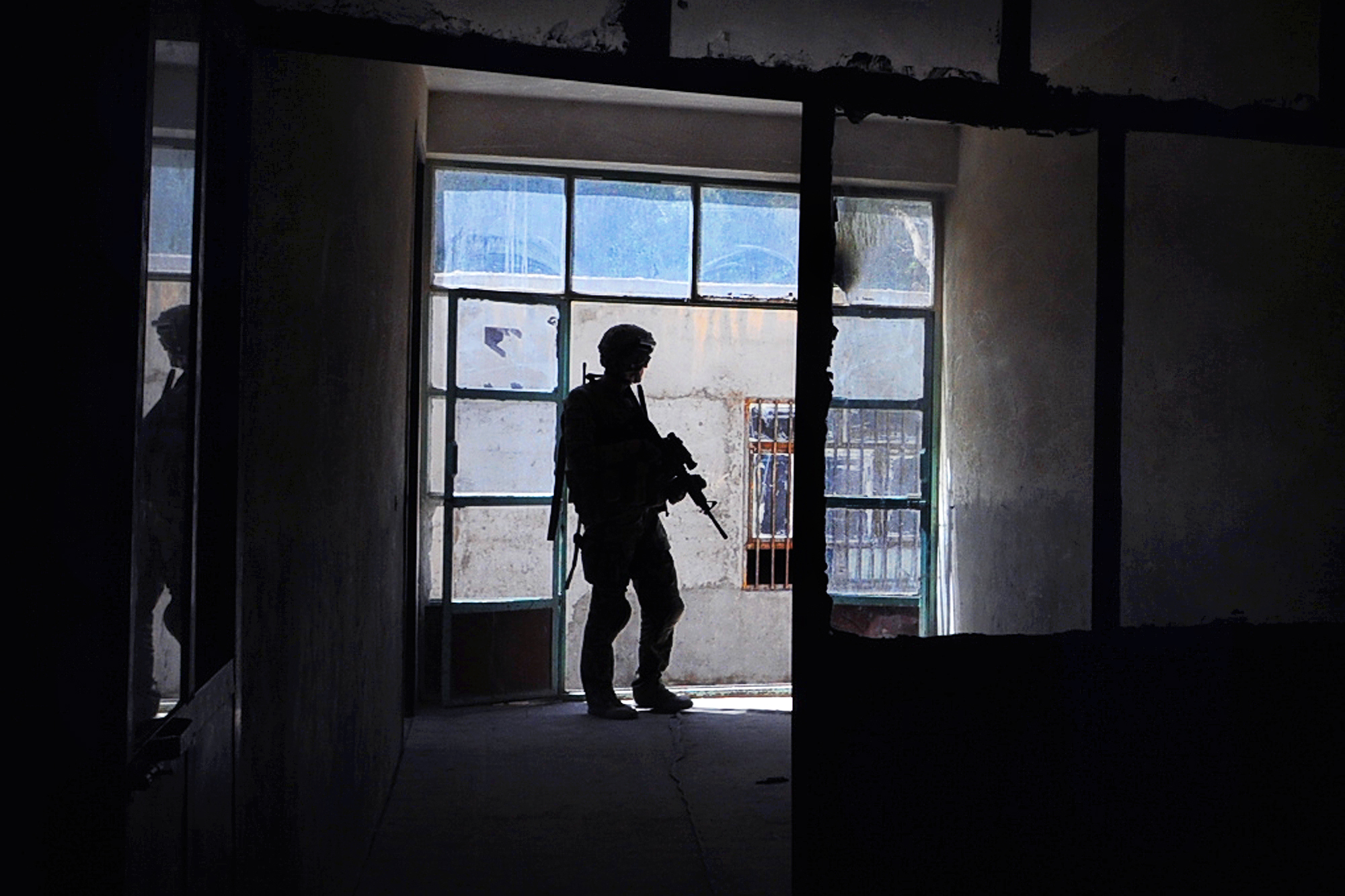
A U.S. Army soldier provides security at a school in Farah City, Afghanistan, on Aug. 1, 2012. (Photo credit: U.S. Navy Lt. Benjamin Addison)
Senior Marine Corps commanders are alleged to have covered up misconduct by lower-ranking members of their service in Afghanistan. General officers in more than one service are described as being abusive leaders who have created poisonous atmospheres in units they have led. Other generals and colonels are identified with seedy behavior ranging from sexual abuse and alcohol abuse to making lecherous comments about members of Congress.
Before we jump to conclusions about what all this says about any broad patterns of bad conduct or bad character in the officer corps, we should note that a concatenation of such stories in the news does not by itself prove the existence of broad, ingrained problems in a service. Perhaps we are seeing part of random fluctuations in the press’ output on this or any other subject, or partly the efforts of some particularly enterprising and energetic journalists who cover the military.
Bearing in mind that there are upwards of 200,000 U.S. military officers on active duty, maybe the bad apples we read about are no more numerous than we should expect to find in other professional populations of comparable size. And maybe most of the problems are best described in terms of individual cases and individual circumstances and do not lend themselves to valid and insightful generalization.
Under the where-there’s-smoke-there-might-be-fire principle, however, it is appropriate to ask whether there may be some overall reasons, applicable to this national military at this time in the nation’s history, for a surge in bad behavior. The U.S. armed forces are coming off more than a decade of continuous involvement in overseas warfare, with the particular wars in question not having gone especially well, or at least ending for the United States in ways well short of what could be called victory.
Stresses that this recent history places on the military as a whole are shared by the officer corps. One thinks, by way of comparison, of the years immediately after the Vietnam War, another overseas war that did not go well and a time when aberrant conduct in the military such as drug abuse was high.
The American public is treating service members returning from the more recent wars, however, much differently from how it treated Vietnam veterans. Today’s uniformed military is routinely applauded at sporting events and otherwise lauded for the service that the other 99 percent of the population is not performing. Maybe herein lies a different sort of explanation for some of the bad conduct.
Maybe being placed on a public pedestal leads some in uniform to feel that they are being given more latitude than others are, and that there is more room for ignoble behavior since it has already been offset by the noble behavior that the public applauds. But that is only a hypothesis, and like any hypothesis it has to deal with the fact that most members of the service, officers as well as enlisted, behave well.
Perhaps relevant is another aspect of the current phase in the history of the U.S. military, which is that it has become more separated from civilian society than perhaps at any earlier time — as measured in part by the small and shrinking proportion of the civilian population that has performed military service.
One can imagine several deleterious consequences of this, some of which can be reflected in the bad news stories about officers. An abusive leadership style, for example, may have something in common with hazing and other abusive behavior in other exclusive, separate cadres. More generally, there may be less exposure to wider societal norms, or more of a notion that those norms don’t apply or don’t apply in the same way to the military.
More military sociology needs to be performed about such questions (or if it has already been performed, it needs to be publicized more). Not very helpful is just to take narrow actions in the name of accountability. The Robert Gates approach of finding someone to fire, whether or not the firee was even aware of whatever is the latest problem to become public, does not help.
It makes the person doing the firing look decisive but offers no reason to believe that things will be better under new management. New management in the Air Force does not seem to have made much positive difference in behavior in the part of the service that handles nuclear weapons.
These issues are not ones to be left only to the military, or to the Department of Defense. They involve the military’s place in larger society, and so larger society has to be involved in thinking about solutions.
Paul R. Pillar, in his 28 years at the Central Intelligence Agency, rose to be one of the agency’s top analysts. He is now a visiting professor at Georgetown University for security studies.

THE GLOBAL ECONOMIC CRISIS, THE GREAT DEPRESSION OF THE XXI CENTURY.

The Global Economic Crisis, The Great Depression of the XXI Century.

Global Research, February 04, 2014

The following text is an excerpt of the Preface of  The Global Economic Crisis. The Great Depression of the XXI Century, Montreal, Global Research, 2010.
In all major regions of the world, the economic recession is deep-seated, resulting in mass unemployment, the collapse of state social programs and the impoverishment of millions of people. The economic crisis is accompanied by a worldwide process of militarization, a “war without borders” led by the United States of America and its NATO allies. The conduct of the Pentagon’s “long war” is intimately related to the restructuring of the global economy.
originalWe are not dealing with a narrowly defined economic crisis or recession. The global financial architecture sustains strategic and national security objectives. In turn, the U.S.-NATO military agenda serves to endorse a powerful business elite which relentlessly overshadows and undermines the functions of civilian government.
This book takes the reader through the corridors of the Federal Reserve and the Council on Foreign Relations, behind closed doors at the Bank for International Settlements, into the plush corporate boardrooms on Wall Street where far-reaching financial transactions are routinely undertaken from computer terminals linked up to major stock markets, at the touch of a mouse button.
Each of the authors in this collection digs beneath the gilded surface to reveal a complex web of deceit and media distortion which serves to conceal the workings of the global economic system and its devastating impacts on people’s lives. Our analysis focuses on the role of powerful economic and political actors in an environment wrought by corruption, financial manipulation and fraud.
Despite the diversity of viewpoints and perspectives presented within this volume, all of the contributors ultimately come to the same conclusion: humanity is at the crossroads of the most serious economic and social crisis in modern history.
The meltdown of financial markets in 2008-2009 was the result of institutionalized fraud and financial manipulation. The “bank bailouts” were implemented on the instructions of Wall Street, leading to the largest transfer of money wealth in recorded history, while simultaneously creating an insurmountable public debt.
With the worldwide deterioration of living standards and plummeting consumer spending, the entire structure of international commodity trade is potentially in jeopardy. The payments system of money transactions is in disarray. Following the collapse of employment, the payment of wages is disrupted, which in turn triggers a downfall in expenditures on necessary consumer goods and services. This dramatic plunge in purchasing power backfires on the productive system, resulting in a string of layoffs, plant closures and bankruptcies. Exacerbated by the freeze on credit, the decline in consumer demand contributes to the demobilization of human and material resources.
This process of economic decline is cumulative. All categories of the labor force are affected. Payments of wages are no longer implemented, credit is disrupted and capital investments are at a standstill. Meanwhile, in Western countries, the “social safety net” inherited from the welfare state, which protects the unemployed during an economic downturn, is also in jeopardy.
 The Myth of Economic Recovery
The existence of a “Great Depression” on the scale of the 1930s, while often acknowledged, is overshadowed by an unbending consensus: “The economy is on the road to recovery”.
While there is talk of an economic renewal, Wall Street commentators have persistently and intentionally overlooked the fact that the financial meltdown is not simply composed of one bubble – the housing real estate bubble – which has already burst. In fact, the crisis has many bubbles, all of which dwarf the housing bubble burst of 2008.
Although there is no fundamental disagreement among mainstream analysts on the occurrence of an economic recovery, there is heated debate as to when it will occur, whether in the next quarter, or in the third quarter of next year, etc. Already in early 2010, the “recovery” of the U.S. economy had been predicted and confirmed through a carefully worded barrage of media disinformation. Meanwhile, the social plight of increased unemployment in America has been scrupulously camouflaged. Economists view bankruptcy as a microeconomic phenomenon.
The media reports on bankruptcies, while revealing local-level realities affecting one or more factories, fail to provide an overall picture of what is happening at the national and international levels. When all these simultaneous plant closures in towns and cities across the land are added together, a very different picture emerges: entire sectors of a national economy are closing down.
Public opinion continues to be misled as to the causes and consequences of the economic crisis, not to mention the policy solutions. People are led to believe that the economy has a logic of its own which depends on the free interplay of market forces, and that powerful financial actors, who pull the strings in the corporate boardrooms, could not, under any circumstances, have willfully influenced the course of economic events.
The relentless and fraudulent appropriation of wealth is upheld as an integral part of “the American dream”, as a means to spreading the benefits of economic growth. As conveyed by Michael Hudson, the myth becomes entrenched that “without wealth at the top, there would be nothing to trickle down.” Such flawed logic of the business cycle overshadows an understanding of the structural and historical origins of the global economic crisis.
 Financial Fraud
Media disinformation largely serves the interests of a handful of global banks and institutional speculators which use their command over financial and commodity markets to amass vast amounts of money wealth. The corridors of the state are controlled by the corporate establishment including the speculators. Meanwhile, the “bank bailouts”, presented to the public as a requisite for economic recovery, have facilitated and legitimized a further process of appropriation of wealth.
Vast amounts of money wealth are acquired through market manipulation. Often referred to as “deregulation”, the financial apparatus has developed sophisticated instruments of outright manipulation and deceit. With inside information and foreknowledge, major financial actors, using the instruments of speculative trade, have the ability to fiddle and rig market movements to their advantage, precipitate the collapse of a competitor and wreck havoc in the economies of developing countries. These tools of manipulation have become an integral part of the financial architecture; they are embedded in the system.
The Failure of Mainstream Economics
The economics profession, particularly in the universities, rarely addresses the actual “real world” functioning of markets. Theoretical constructs centered on mathematical models serve to represent an abstract, fictional world in which individuals are equal. There is no theoretical distinction between workers, consumers or corporations, all of which are referred to as “individual traders”. No single individual has the power or ability to influence the market, nor can there be any conflict between workers and capitalists within this abstract world.
By failing to examine the interplay of powerful economic actors in the “real life” economy, the processes of market rigging, financial manipulation and fraud are overlooked. The concentration and centralization of economic decision-making, the role of the financial elites, the economic thinks tanks, the corporate boardrooms: none of these issues are examined in the universities’ economics programs. The theoretical construct is dysfunctional; it cannot be used to provide an understanding of the economic crisis.
Economic science is an ideological construct which serves to camouflage and justify the New World Order. A set of dogmatic postulates serves to uphold free market capitalism by denying the existence of social inequality and the profit-driven nature of the system is denied. The role of powerful economic actors and how these actors are able to influence the workings of financial and commodity markets is not a matter of concern for the discipline’s theoreticians. The powers of market manipulation which serve to appropriate vast amounts of money wealth are rarely addressed. And when they are acknowledged, they are considered to belong to the realm of sociology or political science.
This means that the policy and institutional framework behind this global economic system, which has been shaped in the course of the last thirty years, is rarely analyzed by mainstream economists. It follows that economics as a discipline, with some exceptions, has not provided the analysis required to comprehend the economic crisis. In fact, its main free market postulates deny the existence of a crisis. The focus of neoclassical economics is on equilibrium, disequilibrium and “market correction” or “adjustment” through the market mechanism, as a means to putting the economy back “onto the path of self-sustained growth”.
 Poverty and Social Inequality
The global political economy is a system that enriches the very few at the expense of the vast majority. The global economic crisis has contributed to widening social inequalities both within and between countries. Under global capitalism, mounting poverty is not the result of a scarcity or a lack of human and material resources. Quite the opposite holds true: the economic depression is marked by a process of disengagement of human resources and physical capital. People’s lives are destroyed. The economic crisis is deep-seated.
The structures of social inequality have, quite deliberately, been reinforced, leading not only to a generalized process of impoverishment but also to the demise of the middle and upper middle income groups.
Middle class consumerism, on which this unruly model of capitalist development is based, is also threatened. Bankruptcies have hit several of the most vibrant sectors of the consumer economy. The middle classes in the West have, for several decades, been subjected to the erosion of their material wealth. While the middle class exists in theory, it is a class built and sustained by household debt.
The wealthy rather than the middle class are rapidly becoming the consuming class, leading to the relentless growth of the luxury goods economy. Moreover, with the drying up of the middle class markets for manufactured goods, a central and decisive shift in the structure of economic growth has occurred. With the demise of the civilian economy, the development of America’s war economy, supported by a whopping near-trillion dollar defense budget, has reached new heights. As stock markets tumble and the recession unfolds, the advanced weapons industries, the military and national security contractors and the up-and-coming mercenary companies (among others) have experienced a thriving and booming growth of their various activities.
 War and the Economic Crisis
War is inextricably linked to the impoverishment of people at home and around the world. Militarization and the economic crisis are intimately related. The provision of essential goods and services to meet basic human needs has been replaced by a profit-driven “killing machine” in support of America’s “Global War on Terror”. The poor are made to fight the poor. Yet war enriches the upper class, which controls industry, the military, oil and banking. In a war economy, death is good for business, poverty is good for society, and power is good for politics. Western nations, particularly the United States, spend hundreds of billions of dollars a year to murder innocent people in far-away impoverished nations, while the people at home suffer the disparities of poverty, class, gender and racial divides.
An outright “economic war” resulting in unemployment, poverty and disease is carried out through the free market. People’s lives are in a freefall and their purchasing power is destroyed. In a very real sense, the last twenty years of global “free market” economy have resulted, through poverty and social destitution, in the lives of millions of people.
Rather than addressing an impending social catastrophe, Western governments, which serve the interests of the economic elites, have installed a “Big Brother” police state, with a mandate to confront and repress all forms of opposition and social dissent.
The economic and social crisis has by no means reached its climax and entire countries, including Greece and Iceland, are at risk. One need only look at the escalation of the Middle East Central Asian war and the U.S.-NATO threats to China, Russia and Iran to witness how war and the economy are intimately related.
Michel Chossudovsky,  Montreal,  May 2010
The book can be ordered directly from Global Research
original

The Global Economic Crisis: The Great Depression of the XXI Century

Contents of this Book
The contributors to this book reveal the intricacies of global banking and its insidious relationship to the military industrial complex and the oil conglomerates. The book presents an inter- disciplinary and multi-faceted approach, while also conveying an understanding of the historical and institutional dimensions. The complex relations of the economic crisis to war, empire and worldwide poverty are highlighted. This crisis has a truly global reach and repercussions that reverberate throughout all nations, across all societies.
In Part I, the overall causes of the global economic crisis as well as the failures of mainstream economics are laid out. Michel Chossudovsky focuses on the history of financial deregulation and speculation. Tanya Cariina Hsu analyzes the role of the American Empire and its relationship to the economic crisis. John Bellamy Foster and Fred Magdoff undertake a comprehensive review of the political economy of the crisis, explaining the central role of monetary policy. James Petras and Claudia von Werlhof provide a detailed review and critique of neoliberalism, focusing on the economic, political and social repercussions of the “free market” reforms. Shamus Cooke examines the central role of debt, both public and private.
Part II, which includes chapters by Michel Chossudovsky and Peter Phillips, analyzes the rising tide of poverty and social inequality resulting from the Great Depression.
CLICK IMAGE TO ORDER
original With contributions by Michel Chossudovsky, Peter Dale Scott, Michael Hudson, Bill Van Auken, Tom Burghardt and Andrew Gavin Marshall, Part III examines the relationship between the economic crisis, National Security, the U.S.-NATO led war and world government. In this context, as conveyed by Peter Dale Scott, the economic crisis creates social conditions which favor the instatement of martial law.
The focus in Part IV is on the global monetary system, its evolution and its changing role. Andrew Gavin Marshall examines the history of central banking as well as various initiatives to create regional and global currency systems. Ellen Brown focuses on the creation of a global central bank and global currency through the Bank for International Settlements (BIS). Richard C. Cook examines the debt-based monetary system as a system of control and provides a framework for democratizing the monetary system.
Part V focuses on the working of the Shadow Banking System, which triggered the 2008 meltdown of financial markets. The chapters by Mike Whitney and Ellen Brown describe in detail how Wall Street’s Ponzi scheme was used to manipulate the market and transfer billions of dollars into the pockets of the banksters.