Wednesday, January 14, 2015

Haiti “Reconstruction”: Luxury Hotels, Sweat Shops and Deregulation for the Foreign Corporate Elite

Haiti “Reconstruction”: Luxury Hotels, Sweat Shops and Deregulation for the Foreign Corporate Elite

Global Research, January 12, 2015
This article was first published on August 16, 2013. Today Haiti commemorates the 5th anniversary of the devastating earthquake.
Picture: Girl in a displacement camp, January 2013. REUTERS, Swoan Parker
“The international community is so screwed up they’re letting Haitians run Haiti.” –Luigi R. Einaudi, US career diplomat, member of the Council on Foreign Relations and former Assistant Secretary General at the Organization of American States
Haitian author and human rights attorney Ezili Dantò heard Luigi R. Einaudi make this shocking comment in 2004, as Haiti was about to celebrate its 200 years of independence with its first democratically elected President, Jean-Bertrand Aristide. Apart from his efforts to raise the minimum wage and other social measures for the majority of Haitians living in extreme poverty, Aristide planned to nationalize his country’s resources, a move which meant more money for Haitians and less for multinationals. One month later, in the name of the “international community”, Aristide was overthrown in a coup d’état orchestrated by the U.S., France and Canada.
Today, the “international community” is running Haiti again, colonial style.
One can easily tell by comparing the very slow construction of shelters and basic infrastructure for the Haitian majority with the rapid rise of luxury hotels for foreigners, sometimes with the help of aid funds which, we were told, were going to provide Haitians with basic necessities.
Most of the aid money went to donor countries’ businesses, government agencies and NGOs, as usual. International “aid” is a well-known capitalist scheme aimed at developing markets in the global south for businesses from the North. Of course this “aid” will benefit Haitians. But only the very few elite ones: those in power and the rich corporate elite. “Haiti’s open for business” and deluxe hotels will be welcoming businessmen so they can set up their sweat shops in a cool and luxurious environment.
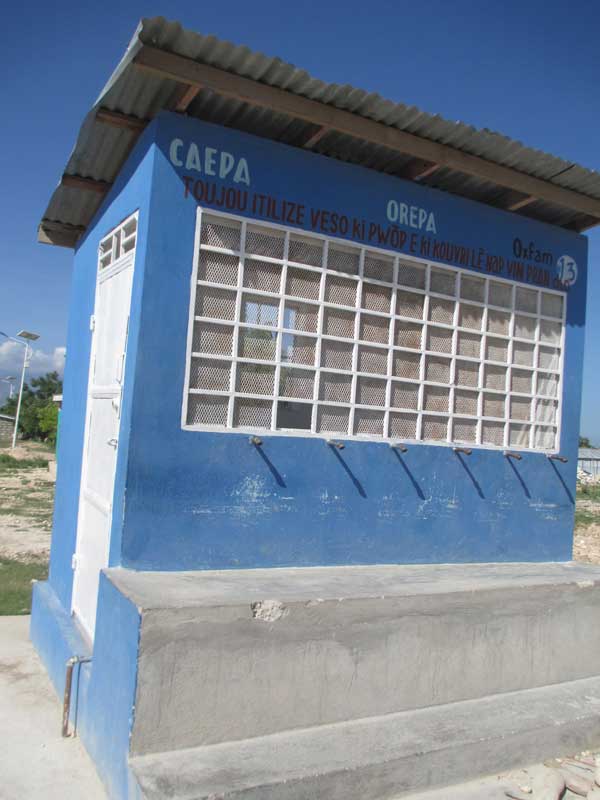
Picture (left): Original caption “Back in 2011, the U.N. and Oxfam promised that a new system of cisterns and kiosks would soon provide residents with water from the state water agency. Two years later, the faucets remain dry [see photo]. Residents buy water at 5 gourdes (about US$0.12 cents) a bucket from private vendors or from the committees that manage the few still-functioning water “bladders” left over from the camp’s early days when water and food were free and when agencies provided “cash for work” jobs and start-up funds for would-be entrepreneurs.” (Reconstruction’s Massive Slum Will Cost “Hundreds Of Millions” Reconstruction’s Massive Slum Will Cost “Hundreds Of Millions” Haiti Grassroots Watch, June 17, 2013)
“Several new luxury hotels in Haiti”
A year ago the Clinton-Bush Haiti Fund invested humanitarian aid money in a five star hotel, as some 500,000 Haitians were still in displaced camps:
Picture (right): Oasis Hotel, Petionville Haiti
As part of the country’s “Reconstruction”, The Clinton-Bush Haiti Fund recently invested $2 million in the Royal Oasis Hotel, a deluxe structure to be built in a poverty-stricken metropolitan area “filled with displaced-persons camps housing hundreds of thousands”. (Julie Lévesque, HAITI: Humanitarian Aid for Earthquake Victims Used to Build Five Star Hotels, Global Research, June 28, 2012)
Now, as 300,000 Haitians are still living in camps, a “new Marriott hotel rising from the rubble in Haiti is getting a $26.5 million financial boost” from the International Financial Corporation (IFC), member of the World Bank Group:
Marriott International and telecom giant Digicel broke ground on the hotel last year, and it is expected to open in 2015. It will be among several new luxury hotels in Haiti after the devastating Jan. 12, 2010 earthquake. Spain’s Occidental Hotels & Resort and U.S.-based Best Western have both opened hotels in the last six months in Petionville, a Port-au-Prince suburb. Spanish hotel chain NH Hotels also will open a new El Rancho in Petionville over the next few months.
IFC officials say the Marriott’s construction is expected to create about 300 jobs. The hotel itself will offer 200 permanent jobs. Marriott Hotels & Resorts will operate the hotel under a long-term management agreement.
The IFC currently has about $78.5 million worth of investments in Haiti, which continues to limp toward recovery more than three years after the quake nearly wiped out its economy. The investments are aimed at creating jobs, access to basic infrastructure, and income opportunities for Haitians, the IFC said.
“Haiti has the fundamental conditions for sustainable economic growth, including a competitive workforce, proximity to major markets, and unique cultural and tourist attractions,” said Ary Naim, IFC Representative for Haiti. “With our long-term financing support for this new and important piece of business infrastructure, we are confirming our commitment and confidence in Haiti’s future.” (Jacqueline Charles New Marriott under construction in Haiti getting financial boost, Miami Herald, July 3, 2013)
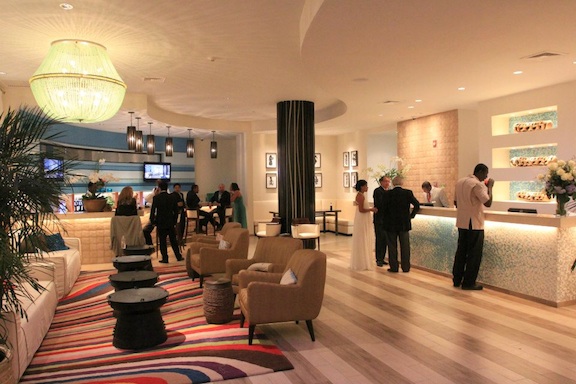
Picture: Best Western Petionville, Haiti.
How a luxury hotel in a rich suburban area helps give the 300,000 displaced and most impoverished Haitians “access to basic infrastructure” has yet to be demonstrated. Moreover, it won’t create jobs for those who need it the most. It is very unlikely that a deluxe hotel in the plush suburb of Petionville will hire many poor, needy, often illiterate Haitians who only speak Creole to work for rich foreigners. These people are the “competitive work force” and end up in sweat shops and mines. What “competitive workforce” and “proximity to major markets” actually mean is “cheap labor for the U.S.”
On its web site the IFC says its investments are “focused on helping rebuild Haiti and reactivate growth through investment and advisory services, in priority sectors such as garment, infrastructure, telecom, tourism, and finance.” In addition to the $26.5 million for the Marriott, the IFC has invested $7.7 million to the aforementioned Oasis hotel, also located in Petionville. (IFC Investment Generation in Haiti)
In total, almost half of IFC investments have helped the construction of deluxe hotels in a rich suburb, home to the Haitian elite.
The World Bank: An Imperial Tool
The IFC is part of the World Bank Group. The World Bank has been criticized for previous initiatives like the Project for Participatory Community Development (PRODEP). An eight month investigation by Haiti Grassroots Watch found that PRODEP “helped undermine an already weak state, damaged Haiti’s ‘social tissue,’ carried out what could be called ‘social and political reengineering,’… raised questions of waste and corruption… contributed to Haiti’s growing status as an ‘NGO Republic’… damaged traditional solidarity systems and in some cases even strengthened the power of local elites.” (World Bank “success” undermines Haitian democracy, Haiti Grassroots Watch, December 20, 2012)
Recently, in May 2013, Alexandre Abrantes, the World Bank special envoy to Haiti announced that the “World Bank is supporting the Haitian government in improving the frameworks for mining, including legal provisions which are largely considered inadequate for current requirements,” Daniel Trenton, (World Bank says its helping Haiti draft mining legislation, The Gazette, May 17, 2013)
For Ezili Dantò, the U.S. and the World Bank are simply rewriting Haiti’s constitution to benefit mining companies:
Oxfam, [the] World Bank and the other fake philanthropic folks [are] involved in protecting the interests of the one percenters, re-writing Haiti mining laws…
ARTICLE 36-5 of the Haitian Constitution, states:
“The right to own property does not extend to the coasts, springs, rivers, water courses, mines and quarries. They are part of the State’s public domain.”
Haiti’s current law doesn’t allow drilling without a signed mining convention. But US Newmont mining got a “waiver” to the current Haiti law without the approval of even the puppet Haiti legislature. Martelly signed it in violation of the Haiti Constitution. (Ezili Dantò, Haiti: US to Re-Write Haiti Constitution to Better Service the One Percent, Black Agenda Report July 2, 2013)
Haitian mineral resources alone have been estimated at $20 billion. “U.S. and Canadian investors have spent more than $30 million in recent years on exploratory drilling and other mining-related activities in Haiti.” (Trenton, op. cit.)
Slow Reconstruction, Slave Labor and the International Aid Deception
Picture left: Jean-Marie Vincent camp, January 2013. AP/Dieu Nalio Chery
Unlike the fast-growing luxury hotel industry, the reconstruction efforts face many delays and various financial hurdles. Last June, a U.S. Government Accountability Office (GAO) report criticised USAID for its lack of transparency, multiple delays, cost overruns and reduced goals. The report points to a striking paradox: although the sums allocated to sheltering have almost doubled, the number of houses to be built has been reduced by an astonishing 80 percent:
In 2010, just months after Haiti was struck by a devastating earthquake, the United States passed legislation allocating $651 million to USAID to support relief and reconstruction efforts. Three years later, just 31 percent of these funds have been spent as delays mount and goals are scaled back… The report also criticizes USAID for a lack of transparency…
The GAO found that inaccurate cost estimates and delays led to an increase in the amount dedicated to providing shelter from $59 million to $97 million while at the same time “decreased the projected number of houses to be built by over 80 percent, from 15,000 to 2,649.” Originally estimated to cost less than $10,000 for a completed house, actual costs have been greater than $33,000. USAID has awarded over $46 million to contractors for housing. Meanwhile, some 300,000 people remain in camps over three years after the earthquake. Overall, the humanitarian community has constructed just 7,000 new homes, about 40 percent of what is currently planned…
Further, the GAO report is critical of U.S. investments supporting the Caracol Industrial Park.  Randal C. Archibold of the New York Times reports:
A big portion of Agency for International Development money, $170.3 million, went toward a power plant and port for an industrial park in northern Haiti that was the centerpiece of United States reconstruction efforts and had been heavily promoted by the State Department and former President Bill Clinton…
Although the aid agency completed the power plant under budget, the port, crucial to the industrial park’s long-term success, is two years behind schedule “due in part to a lack of U.S.A.I.D. expertise in port planning in Haiti,” the report said, and is now vulnerable to cost overruns. (GAO Report Critical of USAID in Haiti, Bolsters Calls for Increased Oversight, Center for Economic and Policy Research, June 26, 2013)
The delays and potential cost overruns related to the construction of Caracol’s essential port are easily explained by the fact that USAID received $72 million for its planning and construction, despite its cruel lack of expertise. Indeed USAID has not built such a structure in the past 40 years:
Despite having “not constructed a port anywhere in the world since the 1970s”, USAID allocated $72 million dollars to build one, according to [the] GAO report released last week. The port is meant to help support the Caracol Industrial Park (CIP) which was constructed with funding from the Inter-American Development Bank (IDB) and $170 million in funding from the U.S. for related infrastructure.  The CIP has been held up as the flagship reconstruction project undertaken by the international community in Haiti. Even after putting aside criticisms of the location, types of jobs and the environmental impact of the CIP, the “success” of the entire project hinges on the new port…
Without any in-house expertise in port construction at USAID, the mission turned to private contractors. HRRW reported in January 2012 that MWH Americas was awarded a “$2.8 million contract to conduct a feasibility study for port infrastructure in northern Haiti.” The expected completion date was May 2012. MWH Americas had previously been criticized for their work in New Orleans, with the Times-Picayune reporting that MWH had “been operating for more than two years under a dubiously awarded contract that has allowed it to overbill the city repeatedly even as the bricks-and-mortar recovery work it oversees has lagged.” (USAID’s Lack of Expertise, Reliance on Contractors Puts Sustainability of Caracol in Doubt, Center for Economic and Policy Research, July 2, 2013)
These examples illustrate perfectly what “international aid” is all about. Ezili Dantò explains:
The NGOs carry out US imperial policies in Haiti in exchange for “charity funding” – which means, they money launder US tax payer and donor dollars and put it in their pockets. US imperial policies is about destroying Haiti manufacturing and local economy, expropriating Haiti natural resources and making a larger Haiti market for their subsidized Wall Street monopolies.
The economic elites made billions upon billions before the $9-billion the US “big-hearted humanitarians” would add to their coffers from laundering earthquake relief dollars largely back to US groups.
But the NGOs and their Hollywood, media and academic cohorts play firemen to the US government’s arsonist role in Haiti and the global south. The professional posers – the white industrial charitable complex – play an underhanded game. For instance “The Center for Economic and Policy Research (CEPR) analyzed the $1.15 billion pledged after the January 2010 quake to Haiti and found that the “vast majority” of the money it could follow went straight to U.S. companies or organizations, more than half in the Washington area alone.” (Ezili Dantò, op. cit.).
“Haitians earn less today than they did under the Duvalier dictatorship”
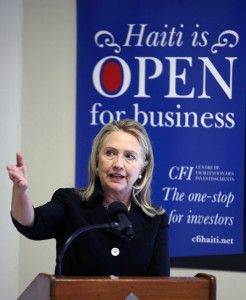
The giant Caracol Industrial Park was inaugurated in March 2013 in the presence of President Martelly, as well as “Haitian and foreign diplomats, the Clinton power couple, millionaires and actors, all present to celebrate the government’s clarion call: ‘Haiti is open for business.’” (The Caracol Industrial Park: Worth the risk? Haiti Grassroots Watch, March 7, 2013)
Caracol was promoted as a way to decentralize the country and potentially create between 20,000 and 65,000 jobs. The results one year later are far from expectations:
One year after it started operations, only 1,388 people work in the park… Also, HGW research amongst a sampling of workers found that at the end of the day, most have only 57 gourdes, or US$1.36, in hand after paying for transportation and food out of their minimum wage 200-gourde (US$4.75) salary.
HGW also learned that most of the farmers kicked off their plots to make way for the park are still without land.
“Before, Caracol was the breadbasket of the Northeast department,” said Breüs Wilcien, one of the farmers expelled from the 250-hectare zone. “Right now there is a shortage of some products in the local markets. We are just sitting here in misery.” (Ibid.)
Destroying food sovereignty in the global south is a common practice used by the global north through international bodies like the World Bank and the IMF. The goal is to keep the South dependent on the North and create a market for exportation, deceptively labelled “food aid” for photo ops and to conceal the real intent: dumping.
Clearly, in addition to providing slave labor for U.S. and other foreign garment companies, the Caracol Industrial Park has contributed to reduce even more what remains of the local farming in Haiti, eradicated over the years by a barbaric U.S. foreign policy. A 2010 report from the Council on Hemispheric Affairs found that Haiti’s “savior” “President Clinton and other recent White House tenants [condemned] Haiti to a future of endemic poverty through a self-serving U.S. rice export policy.” (Leah Chavla, Bill Clinton’s heavy hand on Haiti’s vulnerable agricultural economy: The American rice scandal, Council on Hemispheric Affairs, April 13, 2010)
9587543
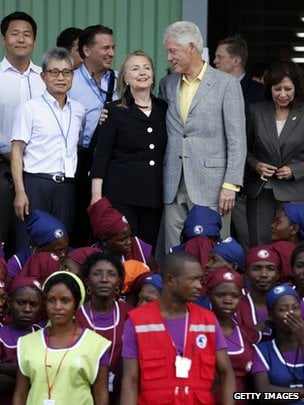
Picture: Notice workers who earn less than $5 a day do not smile. Clinton is the only one smiling. Original caption: “Former U.S. President and U.N. Special Envoy to Haiti, Bill Clinton, smiles as he is greeted by garment workers at the Caracol Industrial Park Monday, Oct. 22, 2012, in Caracol, Haiti. The industrial park in northern Haiti is expected to create up to 65, 000 new jobs. It is a $300 million initiative by the governments of Haiti, the U.S. and the Inter-American Development Bank.” (Clintons visit Haiti to inaugurate new industrial park, The Bee. Picture: Carl Juste, Miami Herald) 
Haiti expert Isabeau Doucet notes:
In the 1950s, agriculture made up 90 per cent of Haiti’s exports; today, 90 per cent of exports are from the apparel sector, while more than half the country’s food is imported…
Preferential free-trade deals signed between Haiti and the United States—named HOPE (Haitian Hemispheric Opportunity through Partnership Encouragement Act, 2006), HOPE II (2008) and HELP (Haiti Economic Lift Program, 2008)—have been part of a push to expand Haiti’s apparel industry by branding “Made in Haiti” garments as somehow humanitarian, socially responsible, and good for Haiti’s “development,” while also giving duty-free access to US markets.
According to a 2011 study by the American Federation of Labor and Congress of Industrial Organizations (AFL-CIO), the estimated cost of living in Port-au-Prince is $29 a day. Two hundred gourdes for an eight-hour work shift is one-sixth the AFL-CIO’s estimated living wage. Transport to and from work and a modest lunch could easily cost a worker 120 gourdes. Indeed, Haitians earn less today than they did under the Duvalier dictatorship; wages have barely increased and are worth half their 1984 purchasing power. (Isabeau Doucet, Made in Haiti, Dumped in Haiti: Slave Labor and the Garment Industry, The Dominion 10 July 2013)
Displaced people dumped on a wasteland
While the tourism industry is rapidly growing, people have been evicted from the city and dumped on a wasteland in a camp called Corail-Cesselesse, also known as “Canaan,” “Jerusalem” and “ONAville”. The camp on the outskirts of Port-au-Prince could “become the country’s most expansive – and most expensive – slum” where there are no jobs and water is hard to find.
Picture: City Hall annex in Croix-des-Bouquets, Canaan.
Today, all of the big agencies have abandoned the Corail camp and its 10,000 residents. Trumpeting their success and claiming to have prepared a “transition” to the local authorities, [International Organization of Migration] IOM, [American Refugee Committee] ARC and World Vision all pulled out (although World Vision still supports the Corail School, which it built). (Reconstruction’s Massive Slum Will Cost “Hundreds Of Millions” Reconstruction’s Massive Slum Will Cost “Hundreds Of Millions” Haiti Grassroots Watch, June 17, 2013)
The international community is not helping rebuild Haiti. It is improving colonialism in Haiti with its companies, using the country’s population as slave labor to boost profits. The startling difference between the slow reconstruction efforts for Haitians as opposed to the rapid rise of the luxury hotel industry shows that in Haiti, the foreigners come first. Sadly white supremacy and slavery are still alive and well in the “pearl of the Antilles”.

Haiti, Five Years After the Earthquake: Fraudulent Reconstruction Under Military Occupation

Haiti, Five Years After the Earthquake: Fraudulent Reconstruction Under Military Occupation

Global Research, January 12, 2015
Five years after the devastating earthquake, numerous massive protests were held against the UN occupation (MINUSTAH) and for the departure of Haitian President Michel Martelly and Prime Minister Laurent Lamothe. The latter finally resigned in December 2014.  These demonstrations did not make their way into the mainstream media in 2014.
Why?
When anti-government protests occur in a country which is not led by a U.S. ally, there is extensive coverage. Haiti’s current leaders are “suitable” for Western leaders, most of all for the U.S. since it actually chooses Haiti’s leaders, not the Haitian people.
On January 12 there will be extensive coverage of the 5th anniversary of the devastating earthquake but the major issues and structural problems will either not be addressed or, at best, will be presented in a way that supports the deceitful notion of the white man’s burden. “Haiti needs our help.” Or does it? And what kind of help are we talking about?
“International aid” is nothing but a capitalist, imperial tool designed to keep the South captive of the North’s disastrous neoliberal policies which hinder genuine development and prevent the South’s economic and political sovereignty.
Where does aid money go? In the very pockets of those who pretend to give.
Haiti is probably the best example of the scam international aid really is.
Bush and Clinton the saviors
As a good neoliberal never letting a serious crisis go to waste, Bill Clinton, saw the 2010 earthquake as a great opportunity. As Dady Chery notes:
[At the beginning of the U.S. Occupation in 1915] a treaty was forced on Haiti that created the post of US High Commissioner, to run the country alongside its hand-picked “Haitian” president… Control of the country’s finances, public works, and public health services were transferred to southern US Democrats who had supported Wilson’s campaign, in much the same way that these are transferred today to USAID and non-governmental organizations (NGO). The idea then was the same as now: all Haiti’s economy should serve the US, and nearly all US dollars paid as wages in Haiti should return to the US.
Clinton saw in the earthquake of 2010 his opportunity to become the new US High Commissioner of Haiti… Within four months of the earthquake, he formed the Interim Commission for the Reconstruction of Haiti (CIRH): a strictly pay-to-play group of officials/rich businessmen from the MINUSTAH countries and others who agreed to contribute armed personnel from their countries or money … in return for a piece of the action in Haiti. After some arm twisting and bribery, the Haitian parliament was forced to declare a state of emergency for 18 months during which Clinton and his CIRH gang could do as they pleased with regard to reconstruction, without risk of liability. One year and a half came and went, and when the Haitian Senate observed that nothing much had been accomplished, the state of emergency was not renewed, and the CIRH was alleged to be fraudulent. (Dady Chery, Haiti: Time for Clinton and Co to Pack and Go, News Junkie Post, December 15, 2014)
Bill Clinton’s nefarious influence on the country is not new. A study of the economic liberalization strategies imposed by the U.S. on Haiti in the 1980s and 1990s showed that “President Clinton and other recent White House tenants condemn[ed] Haiti to a future of endemic poverty through a self-serving U.S. rice export policy”:
The U.S. Agency for International Development (USAID), among other agencies, encouraged Haiti to start exporting manufactured and processed agricultural products, in tandem with emphasizing the need to import grain staples on the international market… U.S. experts worked to disassemble Haiti’s rural economy, even though USAID officials recognized that such a move could increase poverty and contribute to a decline in average Haitian income and health standards. By 2003, approximately 80% of all rice consumed in Haiti was imported from the United States.” (Leah Chavla, Bill Clinton’s Heavy Hand on Haiti’s Vulnerable Agricultural Economy: The American Rice Scandal, Council on Hemispheric Affairs, April 13, 2010.)
The business of disaster relief and international aid
Haiti’s earthquake was an opportunity for “business”. Several industries —mining, garment, tourism, only to name a few— profited from the disaster. Donations have favoured businesses in the donor countries more than Haitians themselves and several projects have seen cost overruns and others ended up being useless due to the critical lack of infrastructure.
It is a well-known and documented fact in independent media circles that international aid is nothing but business masquerading as charity. Approximately 80% of the aid money dedicated to developing countries ends up in the coffers of businesses and non-governmental organizations (NGOs) from the donor countries. Far from helping, this dynamic only creates a relationship of dependency hampering, even preventing the “recipient” country from developing the very structures which could liberate it from this colonial relationship.
While most people working for Western humanitarian organizations are well-intentioned, Western “humanitarian” policies towards countries like Haiti are deliberately designed to maintain the financial superiority of the North on the South. This has been demonstrated by the disastrous effects of the International Monetary Fund’s infamous Structural Adjustment Programs, focused on massive privatization, free trade and which have destroyed local economies, agriculture and food sovereignty in countries which now rely on “food aid”. That’s what happened in Haiti:
While some U.S. government agencies say their programs have been meant to alleviate hunger and promote agricultural production, other programs have helped pry open Haiti’s market, creating millions of new consumers for U.S. agricultural products like rice, poultry, pork and other products while undermining local agricultural production and changing Haitian eating habits.
Because some 50% to 60% of the population still makes their living in the agricultural sector, these policies have had extremely negative effects on the economy at large. For example, a 2006 study from Christian Aid estimated that 831,900 people had been directly affected by the 1995 lowering of tariffs that once protected Haitian sugar, rice, and chicken.
Haiti now imports at least 50% of its food, mostly from the U.S., and has become the second most important importer of U.S. rice on the planet. (Haiti Grassroots Watch HAITI: Aid or Trade? The Nefarious Effects of U.S. Policies, November 6, 2013)
Western NGOs are an imperial tool, writes Ezili Dantò:
The NGOs carry out US imperial policies in Haiti in exchange for “charity funding” – which means, they money launder US tax payer and donor dollars and put it in their pockets. US imperial policies is about destroying Haiti manufacturing and local economy, expropriating Haiti natural resources and making a larger Haiti market for their subsidized Wall Street monopolies. (Ezili Dantò, Haiti: US to Re-Write Haiti Constitution to Better Service the One Percent, Black Agenda Report, July 2, 2013)
According to the U.S. government’s own data, the top 5 contractors which received funds related to Haiti in the last 5 years were, indeed, American:
1. Chemonics International Inc (U.S. international development company) $118,961,374
2. Development Alternatives INC. (U.S. consultant firm) $67,703,366
3. Cce/Dfs Inc (U.S. consultant firm) $20,551,722
4. Tetra Tech INC (U.S. consultant, engineering, etc., firm). $16,294,596
5. Pathfinder International (U.S. NGO) $16,036,859
The top 5 recipients of federal funds for Haiti for the same period were:
1. Ministry of Health Haiti $137,751,752
2. United Nations Stabilization Mission in Haiti $117,111,216
3. New York City Office of Emergency Management $36,912,020
4. Miami City of $35,270,000
5. Miami- Dade Fire Rescue Department $34,070,000
Financing the occupation
Following the Ministry of Health, the most important amount spent by the U.S. in Haiti was on military occupation. In 2013, $117,111,216 was allocated by the U.S. Department of State to the so-called United Nations Stabilization Mission in Haiti (MINUSTAH), for “peacekeeping activities”.
The MINUSTAH was established June 1st2004 after a coup d’état led by the United States, France and Canada which removed from office the democratically elected Jean-Bertrand Aristide, leader of the most popular political party, Fanmi Lavalas. Fanmi Lavalas, which has largely dominated in both elections it participated in, was banned from the 2010 election, “won” by the U.S.’ favoured candidate Michel Martelly. Dady Chery explains:
“Clinton and his cronies had began to search for another way to continue their economic stranglehold on the country, and this would include a suitable Haitian President: specifically, one who would be popular with the young but lack patriotism. They found their man in the vulgar musician Michel Martelly. His election became a mere formality after an electoral commission excluded from participation the Fanmi Lavalas party, which commanded 80 percent of the electorate. Observers from Caricom and the Organization of American States (OAS) legitimized the results despite countless irregularities and ballots from only about 20 percent of the electorate. Such are the conditions under which Michel Martelly was (s)elected President of Haiti.” (Chery, op. cit.)
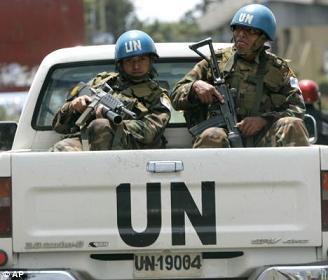
The MINUSTAH’s mandate was extended on October 15, 2014. It should be called an occupation force to reflect its true nature. From the outset its “peacekeeping” operations consisted in political repression of Fanmi Lavalas supporters. It recently fired live bullets on protesters:
During these ten years, MINUSTAH has compiled a horrific record of human rights abuses, including but not limited to extrajudicial murder, an epidemic of sexual assault against Haitian men, women and children, the repression of peaceful political protests, in addition to unleashing cholera through criminal negligence which has caused the death of over 9,000 people and infecting nearly a million more. (Dr. Ajamu Nangwaya and Kevin Edmonds, On October 15, the United Nations Will Fail Haiti Once Again, Global Research, October 14, 2014)
The Haitian Police is also trained by the U.S. private military and security contractor (PMSC) DynCorp.
In April 2013, DynCorp received a $48.6 million contract from the US State Department’s Bureau of International Narcotics and Law Enforcement Affairs, for a one-year base period with three one-year options, for the insertion of its trainees into the UN police force in Haiti. (Dady Chery, Reconstitution of Haiti’s Tontons Macoutes and Their Fusion With MINUSTAH, Haiti Chery, December 24, 2014)
Aid money for luxury hotels and new slums
According to the International Organization for Migration, 80,000 people were still living in camps in December 2014, a 92 per cent decrease since the beginning of the crisis when 1,5 million people were homeless. But the organization does not say where those who left the camps went.
One year ago Haiti Grass Roots Watch wrote that 200,000 earthquake victims had left the makeshift camps for “three large new slums called Canaan, Onaville and Jerusalem.” What about the housing projects paid for by generous donations?
Who lives in them? Who runs them? Can the residents afford the rents or mortgages? Are the residents the earthquake victims?
In total, the new housing projects, with homes for at least 3,588 families, cost US$ 88 million, according to government figures. (In contrast, international donors and private agencies spent more than five times that amount – about US$ 500 million – on “temporary shelters” or T-shelters.) …
On July 21 2011, President Martelly, former US President Bill Clinton and then-Prime Minister Jean Max Bellerive inaugurated the Housing Exposition: a fair featuring about 60 model homes in Zoranje.
Everyone agrees the Expo was a failure. Few visited the site and fewer still chose one of the model homes – many of which were very expensive by Haitian standards – for their project. (HAITI: Reconstruction’s Housing Projects Still Plagued with Problems Four Years After the Earthquake, Haiti Grassroots Watch January 8, 2014)
While hundreds of thousands of people were still living in makeshift camps, large sums of aid money were dedicated to the construction of luxury hotels. As we reported in 2013:
Now, as 300,000 Haitians are still living in camps, a “new Marriott hotel rising from the rubble in Haiti is getting a $26.5 million financial boost” from the International Financial Corporation (IFC), member of the World Bank Group…
The IFC is part of the World Bank Group. The World Bank has been criticized for previous initiatives like the Project for Participatory Community Development (PRODEP). An eight month investigation by Haiti Grassroots Watch found that PRODEP “helped undermine an already weak state, damaged Haiti’s ‘social tissue,’ carried out what could be called ‘social and political reengineering,’… raised questions of waste and corruption… contributed to Haiti’s growing status as an ‘NGO Republic’… damaged traditional solidarity systems and in some cases even strengthened the power of local elites.” (Julie Lévesque, Haiti “Reconstruction”: Luxury Hotels, Sweat Shops and Deregulation for the Foreign Corporate Elite, Global Research, August 16, 2013)
And in 2012:
As part of the country’s “Reconstruction”, The Clinton-Bush Haiti Fund recently invested $2 million in the Royal Oasis Hotel, a deluxe structure to be built in a poverty-stricken metropolitan area “filled with displaced-persons camps housing hundreds of thousands”. (Julie Lévesque, HAITI: Humanitarian Aid for Earthquake Victims Used to Build Five Star Hotels, Global Research, June 28, 2012)
The Royal Oasis, 5 star hotel.
In 2013 it was reported that “Haitians earn less today than they did under the Duvalier dictatorship”. Unless there were any changes within the last year, Haitians who work in the giant Caracol Industrial Park inaugurated in March 2013 end up with a meager US$ 1,36 a day after they paid for food and transportation. If exploitation was not enough, the construction of the giant garment sweatshop kicked farmers off one of the breadbaskets of Haiti when the country is in need of food.
HGW also learned that most of the farmers kicked off their plots to make way for the park are still without land.
“Before, Caracol was the breadbasket of the Northeast department,” said Breüs Wilcien, one of the farmers expelled from the 250-hectare zone. “Right now there is a shortage of some products in the local markets. We are just sitting here in misery.” (The Caracol Industrial Park: Worth the risk? Haiti Grassroots Watch, March 7, 2013)
The anchor tenant of Caracol is Korean apparel manufacturer Sae-A, which provides mass retailers such as Wallmart, and brands including Ralph Lauren, Donna Karen New York, Gap, Zara, Old Navy, H&M.
Haitians have once again been betrayed by the international community:
2015 finds Haitians fighting tooth and nail in renewed political mobilizations to create the nation-building project that big governments and aid agencies pledged but then cruelly betrayed…
[T]he promises of the multi-billion dollar international relief effort and aid which will reach the grassroots have proven largely illusory.
A key admission in the months following the earthquake was that democratic governance and national sovereignty were essential tools for building Haiti on a new and progressive foundation. Today, the lack of democracy and sovereignty is at the epicenter of the political firestorm sweeping the country. (Travis Ross and Roger Annis, Haiti’s Promised Rebuilding is Unfulfilled as Haitians Challenge Authoritarian Rule, Haïti Liberté  January 7, 2015)
Visit our Haiti in-depth report for more information.

Monday, December 8, 2014

« L’essence des médias n’est pas l’information. C’est le pouvoir. »

« L’essence des médias n’est pas l’information. C’est le pouvoir. »

Global Research, décembre 03, 2014
La semaine dernière, le célèbre journaliste John Pilger a participé à une série de Questions-Réponses avec Des Freedman (le 18 novembre 2014), membre de la Media Reform Coalition (coalition pour la réforme des média) ; c’était à l’occasion de la sortie du nouveau livre de Des Freedman « The Contradictions of Media Power » (les contradictions du pouvoir des médias.) Nous avons extrait les meilleures citations de cette intervention de John Pilger, ce qui donne un aperçu de son expérience et de sa compréhension du pouvoir des médias ; nous pouvons tous en apprendre. Et il a véritablement été brillant.

Aujourd’hui les médias sont, comme l’avait décrit le père de la propagande, Edward Bernays, « un gouvernement invisible ». Ils font partie du gouvernement. Ils défendent les intérêts du gouvernement. Le premier ministre est un chargé de relation publique de profession, et pas des meilleurs. C’est tout ce qu’il est. Il ne doit pas être pris au sérieux, c’est juste son rôle. Cette position lui confère certains aspects du pouvoir. Mais le véritable pouvoir réside dans la propagande et les médias. C’est aujourd’hui le cas sur la planète entière.
Durant les prémices de l’invasion de l’Irak, le journalisme a joué un rôle critique dans la concrétisation de l’invasion. Particulièrement aux USA, qui ont – selon la constitution – la presse la plus libre du monde.
Quand je discute de cela avec nombre de collègues distingués aux Etats-Unis et ici, à la suite de l’invasion, ils étaient unanimes, si les journalistes aux postes concernés, à la télévision et dans les journaux (surtout à la télévision, à cause de son pouvoir), si ils avaient contesté les mensonges, s’ils les avaient confrontés, s’ils avaient fait ce qu’est censé faire un journaliste, s’ils avaient, comme le dit Dan Rather de CBS – posé les questions critiques, au lieu d’amplifier et de faire écho aux mensonges, s’ils avaient fait leur travail, ils pensent tous que l’invasion n’aurait pas eu lieu. Le fait qu’ils disent ça, et il s’agit de membres éminents des médias des deux côtés de l’Atlantique, que si les journalistes avaient fait leur travail, l’invasion aurait pu ne pas avoir lieu, et des centaines de milliers de gens seraient encore en vie aujourd’hui. C’est le véritable pouvoir des médias.
Vous travaillez au sein d’un système qui est par nature hostile à la vérité. Je le dis sans ironie, je le pense vraiment. Il est hostile à la vérité. Il suffit de constater la réaction des médias face aux lanceurs d’alertes comme Edward Snowden, Julian Assange. La réaction amère de ceux qui font honte aux médias, tous en chœur.
Il y a ce qu’on appelle la censure par omission. Vous ne discutez pas de ce que vous choisissez d’ignorer, mais ça passe à la trappe.
Si vous remontez à 2008, les histoires sur BBC News, dans tous les journaux, les banques étaient soudainement des escrocs. Quand la Northern Rock s‘est effondrée, les banques étaient des escrocs, elles étaient toutes exposées. Le Guardian était rempli d’articles sépulcreux sur comment les banques étaient pourries de l’intérieur. C’était l’info du jour.
Un aperçu. Cette histoire s’est essoufflée après trois mois et fut totalement inversée, ce n’était plus les banquiers, mais le résultat d’une dette nationale et d’une narrative contrôlée qui était là et qui s’appelait austérité et cette dette devait être payée. Pourquoi ? Pourquoi devait-elle l’être ? Les gens que vous citez (46% des gens pensent que l’austérité va trop loin ou n’est pas nécessaire) c’est une majorité. Si vous obtenez cela dans les sondages, 46%, c’est une majorité. Cela prouve encore que la plupart des gens ont cerné les médias. Ils les ont cernés, en terme de guerre, d’économie, de mode de vie. Nous avons donc entre-aperçu la vérité sur cette criminalité massive, toute cette architecture pourrie s’était effondrée, enfin presque. Les banques furent nationalisées, sans conditions. La conscience des raisons pour lesquelles c’était arrivé, qui fut présente pendant environ 6 mois, fut, grâce à un système de propagande très efficace, totalement effacée. Ce n’était plus la faute des banques, mais « nôtre faute ».
Nous devrions arrêter d’utiliser le terme mainstream. C’est une appellation erronée. Nous en sommes toujours à regarder à travers ce prisme qu’on appelle mainstream. Ce n’est pas du tout mainstream. C’est en réalité extrême. Qu’y-a-t-il de plus extrême qu’une multitude d’institutions qui propagent des guerres illégales et voraces, des mensonges sur les politiques économiques. Qu’y-a-t-il e plus extrême que cela ? Il n’y a rien de mainstream là-dedans. Le plus grand institut de propagande, en Angleterre, c’est la BBC. Et ce parce qu’il est le plus connu. Il bénéficie de la plus grande crédibilité. Sa renommée est mondiale. Par certains aspects ça peut être mérité. Dans le domaine de l’actualité et des affaires courantes, ça ne l’est absolument pas. Et, encore une fois, ce n’est pas de l’ironie. Donc cette idée que l’on se concentre sur les démons, Murdoch, Le Daily Mail (assez mauvais)…d’une certaine façon le Mail et la BBC se complètent l’un l’autre et se suivent… il s’agit de comprendre le spectre de la propagande et la façon dont cela nous affecte.
Les journalistes doivent-ils représenter le peuple ? Oui, bien sûr, mais comme l’a dit Martha Gelhorn : « Tout journalisme doit se faire depuis la base, pas depuis le sommet ». Ce n’est quasiment jamais le cas. Et c’est quelque chose qu’il faut enseigner aux jeunes journalistes. Ces choses élémentaires que vous faites, les sources d’informations les plus fiables, la manière de chercher la vérité, doit se faire depuis la base. C’est mon expérience en tant que reporter. Et j’ai été amené à me rendre compte que ceux qui sont au-dessus de la base, particulièrement ceux d’en-haut, n’étaient pas des sources fiables d’information.
John Pilger

Article original en anglais :
Traduction Nicolas Casaux du 4eme singe

L’entretien intégral : Le président syrien Bachar el-Assad reçoit Paris Match

L’entretien intégral : Le président syrien Bachar el-Assad reçoit Paris Match

Global Research, décembre 05, 2014
Samedi 29 novembre, dans un des bureaux du président syrien, à Damas. Rien ne laisse présager la guerre civile qui se joue au dehors. Sauf des dessins, ceux d’orphelins de soldats réguliers tombés sous le coup d’attentats « terroristes », mêlés à ceux de ses propres enfants. © Paris Match

En exclusivité, l’entretien accordé par le président syrien Bachar El-Assad à Paris Match, le samedi 28 novembre, dans la capitale syrienne.

Monsieur le Président, après trois ans de guerre, au point où nous en sommes aujourd’hui, regrettez-vous de ne pas avoir géré les choses différemment au début, lorsque les premiers signes de révolte sont apparus, en mars 2011 ? Vous sentez-vous responsable ?
Bachar El-Assad. Dès les premiers jours, il y avait des martyrs de l’armée et de la police. Nous avons donc, dès cette époque, fait face au terrorisme. Il y avait des manifestations, certes, mais pas en grand nombre. Notre seul choix était de défendre le peuple contre les terroristes. Il n’y en avait pas d’autres. Nous ne pouvons pas dire que nous le regrettons, puisque nous luttions uniquement contre le terrorisme. Cela ne signifie pas qu’il n’y ait pas eu d’erreurs commises dans la pratique. Il y a toujours des erreurs. Parlons aussi franchement : si le Qatar n’avait pas financé dès le début ces terroristes, si la Turquie ne leur avait pas apporté un soutien logistique et l’Occident un soutien politique, les choses auraient été différentes. La Syrie connaissait des problèmes avant la crise, ce qui est normal, mais cela ne signifie pas qu’il faille trouver aux événements une origine intérieure.
Durant cette guerre, on reproche à votre armée d’avoir utilisé massivement la force. Pourquoi bombarder des civils ?
Lorsqu’un terroriste vous attaque, croyez-vous que vous pouvez vous défendre par le dialogue ? L’armée a eu recours aux armes lorsque l’autre partie en a fait usage. Notre but ne saurait être de frapper les civils. Comment peut-on résister pendant près de quatre ans en tuant des civils, c’est-à-dire son propre peuple, et en même temps combattre les terroristes et les pays hostiles qui les soutiennent, à savoir ceux du Golfe, la Turquie et l’Occident ? Si nous ne défendions pas notre peuple, nous serions incapables de résister. Par conséquent, il n’est pas logique de dire que nous bombardons les civils.
SC_damas_giroudon04.jpe
A gauche, le président Bachar el-Assad et l’envoyé spécial de Paris Match à Damas, Régis Le Sommier.© Paris Match

A PROPOS DE SON DÉPART : “DANS LA TEMPÊTE, LE CAPITAINE NE PREND PAS LA FUITE”

Des images par satellite de Homs ou de Hama montrent des quartiers oblitérés. L’Onu, à laquelle adhère votre pays, parle de 190 000 morts au cours de cette guerre. Les habitants de ces quartiers étaient-ils tous des terroristes ?
D’abord, il faudrait vérifier les statistiques des Nations unies. Quelles en sont les sources ? Les chiffres qui circulent aujourd’hui dans le monde, notamment dans les médias, sont exagérés. Ils sont faux. Ensuite, les images de destructions ne sont pas seulement des photos par satellite, mais des photos prises sur le terrain. Ces destructions sont réelles. Lorsque des terroristes pénètrent dans une région et l’occupent, l’armée doit la libérer. Des combats sont alors engagés. Il est donc normal qu’il y ait destruction. Dans la plupart des cas, lorsque les terroristes s’installent, les civils prennent la fuite. En vérité, le plus grand nombre de victimes en Syrie se compte parmi les partisans de l’Etat et non l’inverse. Beaucoup ont été tués lors d’attentats. Quand vous avez la guerre et le terrorisme, il y a hélas des victimes innocentes. Ça arrive n’importe où, d’ailleurs. Mais il n’est pas concevable qu’un Etat vise ses propres citoyens.
Toujours selon l’Onu, 3 millions de Syriens sont réfugiés dans les pays limitrophes, soit un huitième de la population. Est-ce que ce sont tous des alliés des terroristes ? 
Non, non. La plupart de ceux qui ont quitté la Syrie l’ont fait à cause du terrorisme. Parmi ces réfugiés, certains soutiennent les terroristes, d’autres l’Etat. Ces derniers ont quitté le pays pour des raisons de sécurité. Une grande partie des réfugiés ne soutient personne.

“LES FRAPPES AÉRIENNES DE LA COALITION NE SONT NI SÉRIEUSES NI EFFICACES. ELLES NE NOUS AIDENT PAS”

D’un point de vue militaire, avez-vous les moyens de gagner la guerre ? 
A présent, nous combattons des Etats, pas seulement des bandes. Des milliards de dollars leur sont versés. Des armes leur ont été fournies par des pays comme la Turquie. Il ne s’agit pas d’une guerre facile d’un point de vue militaire. Pourtant, l’armée syrienne progresse dans beaucoup de régions. Personne ne peut encore prévoir quand cette guerre prendra fin, ni comment. Nos adversaires pensaient, au début, gagner le cœur des Syriens. Ils n’y sont pas parvenus. Ils ont perdu le soutien de la population locale. C’est précisément ce qui a permis à l’armée de progresser. Nous devons envisager la guerre d’un point de vue militaire, social et politique.
Mais ils n’ont pas encore perdu, puisque la moitié de votre pays vous échappe.
L’armée syrienne ne peut être partout à la fois. Là où elle n’est pas présente, les terroristes en profitent pour franchir les frontières et s’infiltrer dans telle ou telle zone. Mais chaque fois que l’armée décide de reprendre une région, elle y parvient. Il ne s’agit pas d’une guerre entre deux armées, où l’une occupe un territoire et la seconde un autre. Il s’agit d’un autre type de guerre. Nous avons affaire à des groupes terroristes qui s’infiltrent dans une ville ou dans un village. Cette guerre sera donc longue et difficile.
Beaucoup disent que la solution, c’est votre départ. L’avez-vous vous-même envisagé ?
Partout dans le monde, un chef d’Etat arrive au pouvoir par un mécanisme constitutionnel et le quitte par le même mécanisme. Un président ne peut ni s’imposer ni quitter le pouvoir par le chaos. La preuve tangible, ce sont les conséquences de la politique française en Libye avec la décision d’attaquer Kadhafi. Quel en a été le résultat ? Après son départ, il y a eu le chaos. Son départ était-il la solution ? La situation s’est-elle améliorée ? La Libye est-elle devenue démocratique ? L’Etat est comme un navire : dans la tempête, le capitaine ne prend pas la fuite. Il ne quitte pas le bord. Si les passagers doivent s’en aller, alors il sera le dernier à partir.
Cela veut dire que le capitaine est prêt à mourir. Vous avez évoqué Mouammar Kadhafi. Est-ce que vous avez peur de mourir de la même façon que Saddam Hussein ou Kadhafi ?
Le capitaine ne pense pas à la mort, ni à la vie. Il pense à sauver son navire. S’il fait naufrage, tout le monde mourra. Il vaut donc mieux tout faire pour sauver son pays. Mais je voudrais souligner une chose importante. Mon but n’est pas de rester président, ni avant, ni pendant, ni après la crise. Mais quoi qu’il arrive, nous autres Syriens n’accepterons jamais que notre pays devienne un jouet entre les mains de l’Occident. C’est un principe fondamental pour nous.
Parlons du groupe Etat islamique. On entend dire parfois que, au départ, le régime syrien a encouragé la montée des radicaux islamistes pour diviser l’opposition. Que répondez-vous ?
D’abord, en Syrie, nous avons un Etat, pas un régime. Soyons clairs sur la terminologie. Si nous supposons que cela est vrai, et donc que nous avons soutenu l’Etat islamique, cela revient à dire que nous leur avons demandé de nous attaquer, d’attaquer nos aéroports militaires, de tuer des centaines de nos militaires, d’occuper nos villes et nos villages. Où est la logique là-dedans ? Qu’avions-nous à gagner dans tout cela ? Diviser et affaiblir l’opposition, comme vous le dites ? Nous n’avions pas besoin de le faire. L’Occident lui-même reconnaît que cette opposition était fantoche. C’est ce qu’Obama lui-même a dit. L’hypothèse est donc fausse. Mais alors, où est la vérité ? En réalité, l’Etat islamique a été créé en Irak en 2006. Ce sont bien les Etats-Unis et non la Syrie qui occupaient l’Irak. Abou Bakr Al-Baghdadi était dans les geôles américaines et non dans les prisons syriennes. Qui a donc créé l’Etat islamique ? La Syrie ou les Etats-Unis ?
Les Syriens que nous rencontrons à Damas font plus allusion aux cellules dormantes djihadistes en Occident qu’à la guerre contre l’Etat islamique. C’est étonnant, non ?
Le terrorisme est une idéologie et non une organisation ou une structure. Or, l’idéologie ne connaît pas de frontières. Il y a vingt ans, le terrorisme s’exportait depuis notre région, en particulier depuis les pays du Golfe, comme l’Arabie saoudite. A présent, il nous vient d’Europe, et notamment de France. Le plus gros contingent de terroristes occidentaux venus en Syrie est français. Ils commettent des attentats en France. En Belgique, ils ont attaqué le musée juif. Le terrorisme en Europe n’est plus dormant, il s’est réveillé.
Les Américains sont aujourd’hui, contre l’Etat islamique, des alliés tactiques. Considérez-vous toujours leur intervention comme une violation du territoire syrien ?
Vous avez utilisé le mot “tactique”, et c’est là un point important. Vous savez bien qu’une tactique n’a aucun sens sans une stratégie. Car elle seule n’arrivera pas à venir à bout du terrorisme. Il s’agit d’une intervention illégale, d’abord parce qu’elle n’a pas reçu l’approbation du Conseil de sécurité, ensuite parce qu’elle n’a pas tenu compte de la souveraineté d’un Etat, qui est la Syrie. La réponse est oui. C’est une intervention illégale et donc une violation de la souveraineté nationale.
L’AFP rapporte que votre aviation a effectué 2 000 sorties aériennes en moins de quarante jours, ce qui est énorme. Quand vos avions croisent ceux des Américains, par exemple en allant bombarder Raqqa, existe-t-il un protocole de non-agression ?
Il n’y a pas de coordination directe. Nous attaquons le terrorisme là où il se trouve, sans prendre en considération ce que font les Etats-Unis ou la coalition. Vous seriez sans doute surpris -d’apprendre que le nombre quotidien de sorties de l’aviation syrienne pour frapper les terroristes est supérieur à celui de la coalition. Donc, d’abord, il n’y a pas de coordination. Ensuite, les frappes de la coalition ne sont que cosmétiques.
Mais ces frappes-là vous aident. La démission du secrétaire américain à la Défense, Chuck Hagel, s’explique en partie parce qu’il pensait qu’elles renforçaient votre gouvernement et vos positions.
Notez que votre question contredit celle dans laquelle nous sommes accusés de soutenir Daech. Ça veut dire plutôt que nous sommes des ennemis de Daech.
J’ai dit qu’on entend qu’au départ vous avez soutenu Daech pour diviser l’opposition.
Je ne vous accuse pas, je fais plutôt allusion à ceux qui le pensent.
Maintenant, une des conséquences est cette démission, du point de vue américain. Estimez-vous quand même que les frappes de la coalition vous aident ? 
On ne peut pas mettre fin au terrorisme par des frappes aériennes. Des forces terrestres qui connaissent la géographie et agissent en même temps sont indispensables. C’est la raison pour laquelle il n’y a pas eu de résultats réels après deux mois de campagnes menées par la coalition. Ce n’est donc pas vrai que les frappes de la coalition nous aident. Elles nous auraient certainement aidés si elles étaient sérieuses et efficaces. C’est nous qui menons les combats terrestres contre Daech et nous n’avons constaté aucun changement, surtout que la Turquie apporte toujours un soutien direct dans ces régions.
Le 14 juillet 2008, vous étiez à la tribune, sur les Champs-Elysées, en marge du sommet pour la Méditerranée. Aujourd’hui, le gouvernement français vous considère comme un paria. Comment vivez-vous cette situation ?
Les bonnes relations entre 2008 et 2011 n’étaient pas le résultat d’une initiative française. Il y a eu d’abord les Américains qui ont chargé l’administration française, à l’époque, de faire pression sur la Syrie au sujet de l’Iran. Il y a eu ensuite le Qatar qui poussait la France à améliorer ses relations avec la Syrie. Entretenir de bonnes relations avec nous n’émanait donc pas d’une volonté indépendante de la France. Aujourd’hui, les choses n’ont pas changé. Hollande, comme Sarkozy, n’agit pas de son propre gré.
François Hollande continue de vous considérer comme un adversaire. Pensez-vous qu’à un moment le contact pourra être renoué ?
Ce n’est pas une question de relations personnelles. D’ailleurs, je ne le connais même pas. Il s’agit de relations entre Etats et institutions et dans l’intérêt des deux peuples. Nous traiterons avec tout responsable ou gouvernement français dans l’intérêt commun. Mais l’administration actuelle œuvre à l’encontre des intérêts de notre peuple et de ceux du peuple français. Je ne suis ni l’ennemi personnel ni le rival de Hollande. Je pense que c’est plutôt Daech qui est son rival, puisque leurs cotes de popularité sont très proches.
Oui ou non, y a-t-il aujourd’hui en Syrie des armes chimiques ? 
Non, nous l’avons très clairement déclaré. Et lorsque nous avons décidé de renoncer aux armes chimiques, c’était de manière définitive et totale.
Pourtant, le secrétaire d’Etat américain John Kerry vous accuse d’avoir violé le traité en faisant usage de chlore. Est-ce vrai ?
Vous pouvez trouver du chlore dans n’importe quel foyer syrien. N’importe quelle faction peut l’utiliser. Mais nous, nous ne l’avons pas utilisé, car nous avons des armes conventionnelles plus efficaces, que nous employons dans notre guerre contre les terroristes. Nous ne le cachons pas, car c’est notre droit. Ces accusations ne nous surprennent pas. D’ailleurs, depuis quand les Américains disent-ils la vérité à propos de la crise syrienne ?
Avez-vous utilisé des armes chimiques ?
Nous n’avons pas utilisé ce genre d’armes. Autrement, il y aurait eu des dizaines de morts, sinon des centaines de milliers, et pas simplement 100 ou 200, comme on l’a dit l’année dernière, surtout dans des régions peuplées de centaines de milliers, voire de millions de Syriens.
A l’occasion de votre dernier séjour à Paris, fin 2010, j’avais interviewé votre femme, Asma. Est-ce que ça vous manque de ne plus pouvoir voyager hors de vos frontières ?
Je ne suis pas amateur de voyages et mes visites n’étaient pas pour faire du tourisme. Ce qui me manque vraiment, c’est la Syrie telle qu’elle était. Ce qui nous manque, bien sûr, c’est un monde différent où règnent des relations logiques et morales. Nous avions à l’époque de grands espoirs de développer notre région, de lui assurer une plus grande ouverture intellectuellement. Nous pensions que la France était, par son patrimoine culturel, la mieux placée pour jouer ce rôle avec la Syrie au Moyen-Orient.
Votre épouse se voyait comme une ambassadrice de la modernité. Comment vit-elle cette situation, maintenant qu’elle est recluse en Syrie ?
Comme tous les Syriens, comme moi, elle éprouve de la douleur devant la destruction et le sang versé. Cela nous peine de voir notre patrie revenir des décennies en arrière et devenir un foyer de terrorisme après avoir été parmi les cinq premiers pays sur le plan de la sécurité. Tous les deux, nous sommes navrés de voir l’Occident, qu’on croyait capable d’aider à l’ouverture et au développement, prendre la direction inverse. Pire encore, nous déplorons que ses alliés soient des pays moyenâgeux du Golfe, comme l’Arabie saoudite et le Qatar.
On vous décrit comme quelqu’un d’extrêmement proche de ses enfants. Le soir, en rentrant chez vous, comment leur expliquez-vous ce qui se passe dans votre pays ?
Ce dialogue se déroule dans chaque foyer syrien. Le plus difficile est lorsqu’on a affaire à des enfants dont la conscience sociale s’est formée durant la crise. Les deux principales questions qu’ils posent sont les suivantes : comment des gens qui croient ou disent défendre Dieu et l’islam peuvent-ils tuer et décapiter ? C’est une contradiction difficile à expliquer. Les enfants demandent aussi si ces gens-là savent qu’ils se trompent. La réponse est que certains le savent et exploitent la religion à des fins parti-culières ; d’autres sont des ignorants, qui ne savent pas que la religion, c’est le bien et non le meurtre. Ils nous posent une dernière question : “Pourquoi l’Occident nous attaque-t-il et soutient-il les terroristes ?” Ils ne parlent pas de l’Occident en tant que tel, mais évoquent des pays précis comme les Etats-Unis, la France, la Grande-Bretagne. “Pourquoi agissent-ils de la sorte ? Est-ce qu’on leur a fait du mal ?” Nous leur expliquons alors que les peuples, c’est une chose, et que les Etats, c’en est une autre.

Le Pape entre vérité et diplomatie

Le Pape entre vérité et diplomatie

Global Research, décembre 02, 2014
« Aujourd’hui on dit que beaucoup de choses ne peuvent pas se faire parce que l’argent manque. Et pourtant on trouve de l’argent pour acheter des armes, on en trouve pour faire les guerres » : cette affirmation du Pape François a été ignorée par les milieux gouvernementaux italiens et occidentaux, qui taisent le fait que la dépense militaires mondiale (environ 1750 milliards de dollars annuels selon le Sipri) est entraînée par celle des USA/Otan (plus de 1000 milliards de dollars annuels, plus d’autres dépenses à caractère militaire).
Pratiquement ignorée, dans ces mêmes milieux, l’affirmation du Pape qui sonne indirectement comme une critique au système capitaliste : « Nous sommes en train de vivre une troisième guerre mondiale par morceaux, par chapitres », derrière laquelle se trouvent des problèmes politiques et économiques corrélés à la tentative de « sauver ce système où le Dieu argent est au centre ».
Un relief particulier a par contre été donné, à Rome et dans les autres capitales occidentales, au fait que le Pape, arrivé à Ankara, a exprimé son appréciation pour « le rôle important de la Turquie dans l’aire moyen-orientale, en en soulignant notamment l’engagement humanitaire pour l’accueil des réfugiés fuyant les zones de conflit » (L’Osservatore Romano, 28 novembre). Le Pape avait fait pareil quand, à Amman, il avait remercié le royaume jordanien pour « le généreux accueil fait aux réfugiés irakiens et provenant d’autres zones de crise, en particulier de la Syrie voisine, emportée par un conflit qui dure depuis trop longtemps », en encourageant la Jordanie à « continuer à s’engager dans la recherche de la paix désirée pour toute la région » (L’Osservatore Romano, 24 mai).
Ces déclarations qui font les louanges (probablement sur la base d’un calcul diplomatique) du rôle de la Turquie et de la Jordanie dans la région moyen-orientale et de leur engagement en faveur de réfugiés, se prêtent à être un instrument utile dans la campagne conduite par les gouvernements et par les médias occidentaux pour mystifier la réalité. Ce n’est pas un hasard si le président Napolitano, dans son message à la veille du départ du Pape pour la Turquie, souligne « le rôle crucial qu’Ankara est appelé à jouer dans une région secouée par de fortes tensions et de sanglants conflits ».
En réalité la Turquie et la Jordanie constituent les avant-postes de l’opération guerrière USA/Otan, dont le vrai objectif n’est pas la destruction de l’Emirat islamique, fonctionnel à cette stratégie, mais la démolition de l’Etat syrien (après le yougoslave et le libyen), la reconquête de l’Irak (éventuellement en le démembrant pour pouvoir mieux le contrôler) et en perspective l’attaque de l’Iran. Comme le documentent aussi des enquêtes du New York Times et du Guardian, en Turquie et en Jordanie la Cia a ouvert des centres de formation militaire où sont entraînés des groupes islamiques (auparavant définis comme terroristes par Washington) provenant d’Afghanistan, de Libye et d’autres pays, à infiltrer en Syrie ; y compris les groupes qui ont formé l’EI en Syrie, avant de lancer l’offensive en Irak. Les armes arrivent surtout via l’Arabie Saoudite et le Qatar. En Turquie -où l’Otan a plus de vingt bases aériennes, navales et d’espionnage électronique- a été transféré le Landcom, le commandement allié des forces terrestres des 28 pays membres de l’Otan, y compris donc des forces turques ; il a été activé à Smyrne, d’où il dirige les opérations en Syrie et en Irak. En Jordanie -d’après l’Associated Press (28 novembre)- ont été formées, dans un programme Cia d’entraînement de deux années, les forces rebelles appuyées par les Etats-Unis qui opèrent conjointement avec la branche d’Al Qaeda en Syrie. En provoquant d’autres vagues de réfugiés qui bénéficieront du « généreux accueil » de la Turquie et de la Jordanie.
 Manlio Dinucci
Géographe et journaliste
Edition de mardi 2 décembre 2014 de il manifesto
Traduit de l’italien par Marie-Ange Patrizio