Wednesday, January 14, 2015

Five Years Ago: A Haiti Disaster Relief Scenario Tested by US Military One Day Before the Earthquake

Five Years Ago: A Haiti Disaster Relief Scenario Tested by US Military One Day Before the Earthquake

Global Research, January 13, 2015
A Haiti disaster relief scenario had been envisaged at the headquarters of US Southern Command (SOUTHCOM) in Miami one day prior to the earthquake.
The holding of pre-disaster simulations pertained to the impacts of a hurricane in Haiti. They were held on January 11. (Bob Brewin,  Defense launches online system to coordinate Haiti relief efforts (1/15/10) — GovExec.com, complete text of article is contained in Annex)
The Defense Information Systems Agency (DISA), which is under the jurisdiction of the Department of Defense (DoD), was involved in organizing these scenarios on behalf of US Southern Command.(SOUTHCOM).
Defined as a “Combat Support Agency”, DISA has a mandate to provide IT and telecommunications, systems, logistics services in support of the US military. (See DISA website: Defense Information Systems Agency).
On the day prior to the earthquake, “on Monday [January 11, 2010], Jean Demay, DISA’s technical manager for the agency’s Transnational Information Sharing Cooperation project, happened to be at the headquarters of the U.S. Southern Command in Miami preparing for a test of the system in a scenario that involved providing relief to Haiti in the wake of a hurricane.” (Bob Brewin, op cit, emphasis added)
The Transnational Information Sharing Cooperation project (TISC) is a communications-information tool which  “links non-government organizations with the United States [government and military] and other nations for tracking, coordinating and organizing relief efforts”.(Government IT Scrambles To Help Haiti, TECHWEB January 15, 2010).
The TISC is an essential component of the militarization of emergency relief. The US military through DISA oversees the information – communications system used by participating aid agencies. Essentially, it is a communications sharing system controlled by the US military, which is made available to approved non-governmental partner organizations. The Defense Information Systems Agency also “provides bandwidth to aid organizations involved in Haiti relief efforts.”
There are no details on the nature of the tests conducted on January 11 at SOUTHCOM headquarters.
DISA’s Jean Demay was in charge of coordinating the tests. There are no reports on the participants involved in the disaster relief scenarios.
One would expect, given DISA’s mandate, that the tests pertained to simulating communications. logistics and information systems in the case of a major emergency relief program in Haiti.
The fundamental concept underlying DISA’s Transnational Information Sharing Cooperation project (TISC) is  to “Achieve Interoperability With Warfighters, Coalition Partners And NGOs” (Defense Daily, December 19, 2008)
Upon completing the tests and disaster scenarios on January 11, TISC was considered to be, in relation to Haiti, in “an advanced stage of readiness”. On January 13, the day following the earthquake, SOUTHCOM took the decision to implement the TISC system, which had been rehearsed in Miami two days earlier:
“After the earthquake hit on Tuesday [January 12, 2010], Demay said SOUTHCOM decided to go live with the system. On [the following day] Wednesday [January 13, 2010], DISA opened up its All Partners Access Network, supported by the Transnational Information Sharing Cooperation project, to any organization supporting Haiti relief efforts.
The information sharing project, developed with backing from both SOUTHCOM and the Defense Department’s European Command, has been in development for three years.It is designed to facilitate multilateral collaboration between federal and nongovernmental agencies.
Demay said that since DISA set up a Haiti Humanitarian Assistance and Disaster Relief Community of Interest on APAN on Wednesday [the day following the earthquake], almost 500 organizations and individuals have joined, including a range of Defense units and various nongovernmental organizations and relief groups. (Bob Brewin, Defense launches online system to coordinate Haiti relief efforts (1/15/10) — GovExec.com emphasis added)
DISA has a Southern Command (SOUTHCOM) Field Office in Miami. Under the Haiti Disaster Emergency Program initiated on January 12, DISA’s mandate is described as part of a carefully planned military operation:
“DISA is providing US Southern Command with information capabilities which will support our nation in quickly responding to the critical situation in Haiti,” said Larry K. Huffman, DISA’s Principal Director of Global Information Grid Operations. “Our experience in providing support to contingency operations around the world postures us to be responsive in meeting USSOUTHCOM’s requirements.”
DISA, a Combat Support Agency, engineers and [sic] provides command and control capabilities and enterprise infrastructure to continuously operate and assure a global net-centric enterprise in direct support to joint warfighters, National level leaders, and other mission and coalition partners across the full spectrum of operations. As DoD’s satellite communications leader, DISA is using the Defense Satellite Communications System to provide frequency and bandwidth support to all organizations in the Haitian relief effort. This includes Super High Frequency missions that are providing bandwidth for US Navy ships and one Marine Expeditionary Unit that will arrive shortly on station to provide medical help, security, and helicopters among other support. This also includes all satellite communications for the US Air Force handling round-the-clock air traffic control and air freight operations at the extremely busy Port-Au-Prince Airport. DISA is also providing military Ultra High Frequency channels and contracting for additional commercial SATCOM missions that greatly increase this capability for relief efforts. (DISA -Press Release, January 2010, undated, emphasis added)
In the immediate wake of the earthquake, DISA played a key supportive role to SOUTHCOM, which was designated by the Obama administration as the de facto “lead agency” in the US Haitian relief program. The underlying system consists in integrating civilian aid agencies into the orbit of an advanced communications information system controlled by the US military.
“DISA is also leveraging a new technology in Haiti that is already linking NGOs, other nations and US forces together to track, coordinate and better organize relief efforts” (Ibid)
Related article
Michel Chossudovsky is Professor of Economics (Emeritus) at the University of Ottawa and Director of the Centre for Research on Globalization (CRG) (Montreal), which hosts the award-winning website: www.globalresearch.ca. He is the author of the international best-seller The Globalisation of Poverty and The New World Order and contributor to the Encyclopaedia Britannica. He is member of the Kuala Lumpur War Crimes Commission and recipient of the Human Rights Prize of the Society for the Protection of Civil Rights and Human Dignity (GBM), Berlin, Germany. His writings have been published into more than twenty languages.
ANNEX
Defense launches online system to coordinate Haiti relief efforts
By Bob Brewin, Govexec.com 01/15/2010
As personnel representing hundreds of government and nongovernmental agencies from around the world rush to the aid of earthquake-devastated Haiti, the Defense Information Systems Agency has launched a Web portal with multiple social networking tools to aid in coordinating their efforts.
On Monday [January 11, 2010, a day before the earthquake], Jean Demay, DISA’s technical manager for the agency’s Transnational Information Sharing Cooperation project, happened to be at the headquarters of the U.S. Southern Command in Miami preparing for a test of the system in a scenario that involved providing relief to Haiti in the wake of a hurricane. After the earthquake hit on Tuesday [January 12, 2010], Demay said SOUTHCOM decided to go live with the system. On Wednesday [January 13, 2010], DISA opened up its All Partners Access Network, supported by the Transnational Information Sharing Cooperation project, to any organization supporting Haiti relief efforts.
The information sharing project, developed with backing from both SOUTHCOM and the Defense Department’s European Command, has been in development for three years. It is designed to facilitate multilateral collaboration between federal and nongovernmental agencies.
Demay said that since DISA set up a Haiti Humanitarian Assistance and Disaster Relief Community of Interest on APAN on Wednesday, almost 500 organizations and individuals have joined, including a range of Defense units and various nongovernmental organizations and relief groups.
APAN provides a series of collaboration tools, including geographical information systems, wikis, YouTube and MySpace-like pages and multilingual chat rooms.
Meanwhile, other organizations are tackling different technological challenges. Gianluca Bruni, the Dubai-based information technology chief for emergency preparedness and response for the World Food Programme, is setting up networks and systems to support United Nations and nongovernmental organizations in Haiti. WFP already has dispatched two communications kits to Haiti, with satellite systems that operate at 1 megabit per second and can support up to 100 users. It also has sent laptop computers, Wi-Fi access points and long-range point-to-point wireless systems to connect remote users to the satellite terminals. Bruni said eventually WFP plans to set up cyber cafés in Haiti for use all relief workers in the country.
Jon Anderson, a DISA spokesman, said the agency is supplying 10 megabits of satellite capacity to Navy, Marine and Air Force units engaged in the Haiti relief operation.
Many of the relief organizations and agencies in Haiti are bringing their own radio systems to the country. DISA has deployed a three-person team from its Joint Spectrum Management Element to help manage radio frequency spectrum.
The Joint Forces Command’s Joint Communications Support Element deployed two teams equipped with satellite systems and VoIP phones to support SOUTCOM in Port-au-Prince late Wednesday. Those systems were operational “in a matter of hours,” said JCSE Chief of Staff Chris Wilson. The organization will send another team to Haiti in the next few days.
Wilson said JCSE was able to get its gear into Haiti quickly because the systems already were loaded on pallets in Miami in preparation for an exercise that has been canceled.
So many governments and agencies from around the world have responded to the crisis in Haiti that they have overwhelmed the ability of the Port-au-Prince airport to handle incoming relief flights. The Federal Aviation Administration has had a ground-stop on aircraft headed for Haiti for much of the past two days.
FAA warned in an advisory Friday that “due to limited ramp space at Port-au-Prince airport,” with the exception of international cargo flights, “the Haitians are not accepting any aircraft into their airspace.”
The advisory added that domestic U.S. military and civilian flights to Haiti must be first be cleared by its command center. Exemptions will be based solely on the basis of ramp space. The agency also starkly warned “there is no available fuel” at the Port-au-Prince airport.
Copyright Bob Brewin, Govexec.com, 2010.
AMERICA’S “WAR ON TERRORISM”
by Michel Chossudovsky
CLICK TO ORDER

In this new and expanded edition of Michel Chossudovsky’s 2002 best seller, the author blows away the smokescreen put up by the mainstream media, that 9/11 was an attack on America by “Islamic terrorists”.  Through meticulous research, the author uncovers a military-intelligence ploy behind the September 11 attacks, and the cover-up and complicity of key members of the Bush Administration.
The expanded edition, which includes twelve new chapters focuses on the use of 9/11 as a pretext for the invasion and illegal occupation of Iraq, the militarisation of justice and law enforcement and the repeal of democracy.
According to Chossudovsky, the  “war on terrorism” is a complete fabrication based on the illusion that one man, Osama bin Laden, outwitted the $40 billion-a-year American intelligence apparatus. The “war on terrorism” is a war of conquest. Globalisation is the final march to the “New World Order”, dominated by Wall Street and the U.S. military-industrial complex.
September 11, 2001 provides a justification for waging a war without borders. Washington’s agenda consists in extending the frontiers of the American Empire to facilitate complete U.S. corporate control, while installing within America the institutions of the Homeland Security State.
Chossudovsky peels back layers of rhetoric to reveal a complex web of deceit aimed at luring the American people and the rest of the world into accepting a military solution which threatens the future of humanity.
The last chapter includes an analysis of the London  7/7 Bomb Attacks.
CLICK TO ORDER (mail order or online order)
America’s “War on Terrorism”

Haiti “Reconstruction”: Luxury Hotels, Sweat Shops and Deregulation for the Foreign Corporate Elite

Haiti “Reconstruction”: Luxury Hotels, Sweat Shops and Deregulation for the Foreign Corporate Elite

Global Research, January 12, 2015
This article was first published on August 16, 2013. Today Haiti commemorates the 5th anniversary of the devastating earthquake.
Picture: Girl in a displacement camp, January 2013. REUTERS, Swoan Parker
“The international community is so screwed up they’re letting Haitians run Haiti.” –Luigi R. Einaudi, US career diplomat, member of the Council on Foreign Relations and former Assistant Secretary General at the Organization of American States
Haitian author and human rights attorney Ezili Dantò heard Luigi R. Einaudi make this shocking comment in 2004, as Haiti was about to celebrate its 200 years of independence with its first democratically elected President, Jean-Bertrand Aristide. Apart from his efforts to raise the minimum wage and other social measures for the majority of Haitians living in extreme poverty, Aristide planned to nationalize his country’s resources, a move which meant more money for Haitians and less for multinationals. One month later, in the name of the “international community”, Aristide was overthrown in a coup d’état orchestrated by the U.S., France and Canada.
Today, the “international community” is running Haiti again, colonial style.
One can easily tell by comparing the very slow construction of shelters and basic infrastructure for the Haitian majority with the rapid rise of luxury hotels for foreigners, sometimes with the help of aid funds which, we were told, were going to provide Haitians with basic necessities.
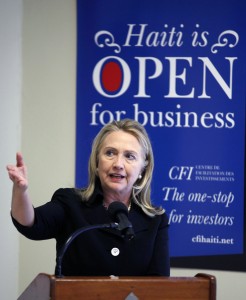
Most of the aid money went to donor countries’ businesses, government agencies and NGOs, as usual. International “aid” is a well-known capitalist scheme aimed at developing markets in the global south for businesses from the North. Of course this “aid” will benefit Haitians. But only the very few elite ones: those in power and the rich corporate elite. “Haiti’s open for business” and deluxe hotels will be welcoming businessmen so they can set up their sweat shops in a cool and luxurious environment.
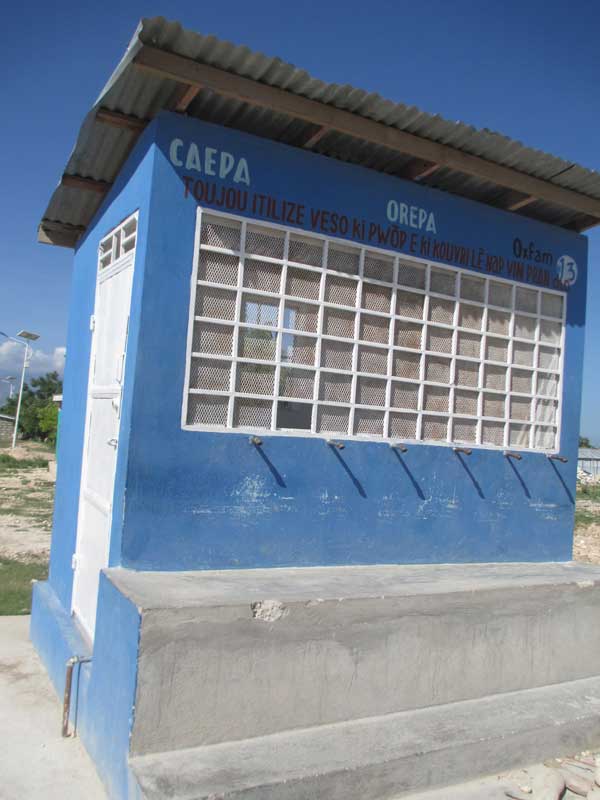
Picture (left): Original caption “Back in 2011, the U.N. and Oxfam promised that a new system of cisterns and kiosks would soon provide residents with water from the state water agency. Two years later, the faucets remain dry [see photo]. Residents buy water at 5 gourdes (about US$0.12 cents) a bucket from private vendors or from the committees that manage the few still-functioning water “bladders” left over from the camp’s early days when water and food were free and when agencies provided “cash for work” jobs and start-up funds for would-be entrepreneurs.” (Reconstruction’s Massive Slum Will Cost “Hundreds Of Millions” Reconstruction’s Massive Slum Will Cost “Hundreds Of Millions” Haiti Grassroots Watch, June 17, 2013)
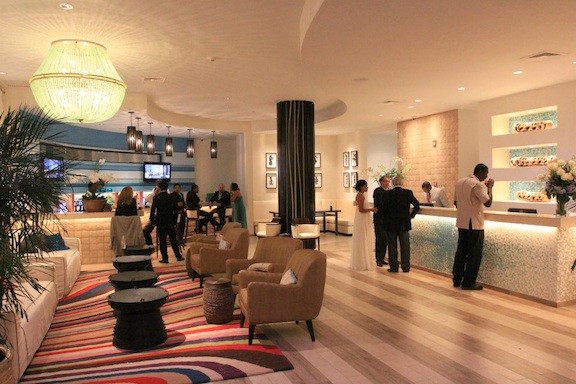
“Several new luxury hotels in Haiti”
A year ago the Clinton-Bush Haiti Fund invested humanitarian aid money in a five star hotel, as some 500,000 Haitians were still in displaced camps:
Picture (right): Oasis Hotel, Petionville Haiti
As part of the country’s “Reconstruction”, The Clinton-Bush Haiti Fund recently invested $2 million in the Royal Oasis Hotel, a deluxe structure to be built in a poverty-stricken metropolitan area “filled with displaced-persons camps housing hundreds of thousands”. (Julie Lévesque, HAITI: Humanitarian Aid for Earthquake Victims Used to Build Five Star Hotels, Global Research, June 28, 2012)
Now, as 300,000 Haitians are still living in camps, a “new Marriott hotel rising from the rubble in Haiti is getting a $26.5 million financial boost” from the International Financial Corporation (IFC), member of the World Bank Group:
Marriott International and telecom giant Digicel broke ground on the hotel last year, and it is expected to open in 2015. It will be among several new luxury hotels in Haiti after the devastating Jan. 12, 2010 earthquake. Spain’s Occidental Hotels & Resort and U.S.-based Best Western have both opened hotels in the last six months in Petionville, a Port-au-Prince suburb. Spanish hotel chain NH Hotels also will open a new El Rancho in Petionville over the next few months.
IFC officials say the Marriott’s construction is expected to create about 300 jobs. The hotel itself will offer 200 permanent jobs. Marriott Hotels & Resorts will operate the hotel under a long-term management agreement.
The IFC currently has about $78.5 million worth of investments in Haiti, which continues to limp toward recovery more than three years after the quake nearly wiped out its economy. The investments are aimed at creating jobs, access to basic infrastructure, and income opportunities for Haitians, the IFC said.
“Haiti has the fundamental conditions for sustainable economic growth, including a competitive workforce, proximity to major markets, and unique cultural and tourist attractions,” said Ary Naim, IFC Representative for Haiti. “With our long-term financing support for this new and important piece of business infrastructure, we are confirming our commitment and confidence in Haiti’s future.” (Jacqueline Charles New Marriott under construction in Haiti getting financial boost, Miami Herald, July 3, 2013)
Picture: Best Western Petionville, Haiti.
How a luxury hotel in a rich suburban area helps give the 300,000 displaced and most impoverished Haitians “access to basic infrastructure” has yet to be demonstrated. Moreover, it won’t create jobs for those who need it the most. It is very unlikely that a deluxe hotel in the plush suburb of Petionville will hire many poor, needy, often illiterate Haitians who only speak Creole to work for rich foreigners. These people are the “competitive work force” and end up in sweat shops and mines. What “competitive workforce” and “proximity to major markets” actually mean is “cheap labor for the U.S.”
On its web site the IFC says its investments are “focused on helping rebuild Haiti and reactivate growth through investment and advisory services, in priority sectors such as garment, infrastructure, telecom, tourism, and finance.” In addition to the $26.5 million for the Marriott, the IFC has invested $7.7 million to the aforementioned Oasis hotel, also located in Petionville. (IFC Investment Generation in Haiti)
In total, almost half of IFC investments have helped the construction of deluxe hotels in a rich suburb, home to the Haitian elite.
The World Bank: An Imperial Tool
The IFC is part of the World Bank Group. The World Bank has been criticized for previous initiatives like the Project for Participatory Community Development (PRODEP). An eight month investigation by Haiti Grassroots Watch found that PRODEP “helped undermine an already weak state, damaged Haiti’s ‘social tissue,’ carried out what could be called ‘social and political reengineering,’… raised questions of waste and corruption… contributed to Haiti’s growing status as an ‘NGO Republic’… damaged traditional solidarity systems and in some cases even strengthened the power of local elites.” (World Bank “success” undermines Haitian democracy, Haiti Grassroots Watch, December 20, 2012)
Recently, in May 2013, Alexandre Abrantes, the World Bank special envoy to Haiti announced that the “World Bank is supporting the Haitian government in improving the frameworks for mining, including legal provisions which are largely considered inadequate for current requirements,” Daniel Trenton, (World Bank says its helping Haiti draft mining legislation, The Gazette, May 17, 2013)
For Ezili Dantò, the U.S. and the World Bank are simply rewriting Haiti’s constitution to benefit mining companies:
Oxfam, [the] World Bank and the other fake philanthropic folks [are] involved in protecting the interests of the one percenters, re-writing Haiti mining laws…
ARTICLE 36-5 of the Haitian Constitution, states:
“The right to own property does not extend to the coasts, springs, rivers, water courses, mines and quarries. They are part of the State’s public domain.”
Haiti’s current law doesn’t allow drilling without a signed mining convention. But US Newmont mining got a “waiver” to the current Haiti law without the approval of even the puppet Haiti legislature. Martelly signed it in violation of the Haiti Constitution. (Ezili Dantò, Haiti: US to Re-Write Haiti Constitution to Better Service the One Percent, Black Agenda Report July 2, 2013)
Haitian mineral resources alone have been estimated at $20 billion. “U.S. and Canadian investors have spent more than $30 million in recent years on exploratory drilling and other mining-related activities in Haiti.” (Trenton, op. cit.)
Slow Reconstruction, Slave Labor and the International Aid Deception
Picture left: Jean-Marie Vincent camp, January 2013. AP/Dieu Nalio Chery
Unlike the fast-growing luxury hotel industry, the reconstruction efforts face many delays and various financial hurdles. Last June, a U.S. Government Accountability Office (GAO) report criticised USAID for its lack of transparency, multiple delays, cost overruns and reduced goals. The report points to a striking paradox: although the sums allocated to sheltering have almost doubled, the number of houses to be built has been reduced by an astonishing 80 percent:
In 2010, just months after Haiti was struck by a devastating earthquake, the United States passed legislation allocating $651 million to USAID to support relief and reconstruction efforts. Three years later, just 31 percent of these funds have been spent as delays mount and goals are scaled back… The report also criticizes USAID for a lack of transparency…
The GAO found that inaccurate cost estimates and delays led to an increase in the amount dedicated to providing shelter from $59 million to $97 million while at the same time “decreased the projected number of houses to be built by over 80 percent, from 15,000 to 2,649.” Originally estimated to cost less than $10,000 for a completed house, actual costs have been greater than $33,000. USAID has awarded over $46 million to contractors for housing. Meanwhile, some 300,000 people remain in camps over three years after the earthquake. Overall, the humanitarian community has constructed just 7,000 new homes, about 40 percent of what is currently planned…
Further, the GAO report is critical of U.S. investments supporting the Caracol Industrial Park.  Randal C. Archibold of the New York Times reports:
A big portion of Agency for International Development money, $170.3 million, went toward a power plant and port for an industrial park in northern Haiti that was the centerpiece of United States reconstruction efforts and had been heavily promoted by the State Department and former President Bill Clinton…
Although the aid agency completed the power plant under budget, the port, crucial to the industrial park’s long-term success, is two years behind schedule “due in part to a lack of U.S.A.I.D. expertise in port planning in Haiti,” the report said, and is now vulnerable to cost overruns. (GAO Report Critical of USAID in Haiti, Bolsters Calls for Increased Oversight, Center for Economic and Policy Research, June 26, 2013)
The delays and potential cost overruns related to the construction of Caracol’s essential port are easily explained by the fact that USAID received $72 million for its planning and construction, despite its cruel lack of expertise. Indeed USAID has not built such a structure in the past 40 years:
Despite having “not constructed a port anywhere in the world since the 1970s”, USAID allocated $72 million dollars to build one, according to [the] GAO report released last week. The port is meant to help support the Caracol Industrial Park (CIP) which was constructed with funding from the Inter-American Development Bank (IDB) and $170 million in funding from the U.S. for related infrastructure.  The CIP has been held up as the flagship reconstruction project undertaken by the international community in Haiti. Even after putting aside criticisms of the location, types of jobs and the environmental impact of the CIP, the “success” of the entire project hinges on the new port…
Without any in-house expertise in port construction at USAID, the mission turned to private contractors. HRRW reported in January 2012 that MWH Americas was awarded a “$2.8 million contract to conduct a feasibility study for port infrastructure in northern Haiti.” The expected completion date was May 2012. MWH Americas had previously been criticized for their work in New Orleans, with the Times-Picayune reporting that MWH had “been operating for more than two years under a dubiously awarded contract that has allowed it to overbill the city repeatedly even as the bricks-and-mortar recovery work it oversees has lagged.” (USAID’s Lack of Expertise, Reliance on Contractors Puts Sustainability of Caracol in Doubt, Center for Economic and Policy Research, July 2, 2013)
These examples illustrate perfectly what “international aid” is all about. Ezili Dantò explains:
The NGOs carry out US imperial policies in Haiti in exchange for “charity funding” – which means, they money launder US tax payer and donor dollars and put it in their pockets. US imperial policies is about destroying Haiti manufacturing and local economy, expropriating Haiti natural resources and making a larger Haiti market for their subsidized Wall Street monopolies.
The economic elites made billions upon billions before the $9-billion the US “big-hearted humanitarians” would add to their coffers from laundering earthquake relief dollars largely back to US groups.
But the NGOs and their Hollywood, media and academic cohorts play firemen to the US government’s arsonist role in Haiti and the global south. The professional posers – the white industrial charitable complex – play an underhanded game. For instance “The Center for Economic and Policy Research (CEPR) analyzed the $1.15 billion pledged after the January 2010 quake to Haiti and found that the “vast majority” of the money it could follow went straight to U.S. companies or organizations, more than half in the Washington area alone.” (Ezili Dantò, op. cit.).
“Haitians earn less today than they did under the Duvalier dictatorship”
The giant Caracol Industrial Park was inaugurated in March 2013 in the presence of President Martelly, as well as “Haitian and foreign diplomats, the Clinton power couple, millionaires and actors, all present to celebrate the government’s clarion call: ‘Haiti is open for business.’” (The Caracol Industrial Park: Worth the risk? Haiti Grassroots Watch, March 7, 2013)
Caracol was promoted as a way to decentralize the country and potentially create between 20,000 and 65,000 jobs. The results one year later are far from expectations:
One year after it started operations, only 1,388 people work in the park… Also, HGW research amongst a sampling of workers found that at the end of the day, most have only 57 gourdes, or US$1.36, in hand after paying for transportation and food out of their minimum wage 200-gourde (US$4.75) salary.
HGW also learned that most of the farmers kicked off their plots to make way for the park are still without land.
“Before, Caracol was the breadbasket of the Northeast department,” said Breüs Wilcien, one of the farmers expelled from the 250-hectare zone. “Right now there is a shortage of some products in the local markets. We are just sitting here in misery.” (Ibid.)
Destroying food sovereignty in the global south is a common practice used by the global north through international bodies like the World Bank and the IMF. The goal is to keep the South dependent on the North and create a market for exportation, deceptively labelled “food aid” for photo ops and to conceal the real intent: dumping.
Clearly, in addition to providing slave labor for U.S. and other foreign garment companies, the Caracol Industrial Park has contributed to reduce even more what remains of the local farming in Haiti, eradicated over the years by a barbaric U.S. foreign policy. A 2010 report from the Council on Hemispheric Affairs found that Haiti’s “savior” “President Clinton and other recent White House tenants [condemned] Haiti to a future of endemic poverty through a self-serving U.S. rice export policy.” (Leah Chavla, Bill Clinton’s heavy hand on Haiti’s vulnerable agricultural economy: The American rice scandal, Council on Hemispheric Affairs, April 13, 2010)
9587543
Picture: Notice workers who earn less than $5 a day do not smile. Clinton is the only one smiling. Original caption: “Former U.S. President and U.N. Special Envoy to Haiti, Bill Clinton, smiles as he is greeted by garment workers at the Caracol Industrial Park Monday, Oct. 22, 2012, in Caracol, Haiti. The industrial park in northern Haiti is expected to create up to 65, 000 new jobs. It is a $300 million initiative by the governments of Haiti, the U.S. and the Inter-American Development Bank.” (Clintons visit Haiti to inaugurate new industrial park, The Bee. Picture: Carl Juste, Miami Herald) 
Haiti expert Isabeau Doucet notes:
In the 1950s, agriculture made up 90 per cent of Haiti’s exports; today, 90 per cent of exports are from the apparel sector, while more than half the country’s food is imported…
Preferential free-trade deals signed between Haiti and the United States—named HOPE (Haitian Hemispheric Opportunity through Partnership Encouragement Act, 2006), HOPE II (2008) and HELP (Haiti Economic Lift Program, 2008)—have been part of a push to expand Haiti’s apparel industry by branding “Made in Haiti” garments as somehow humanitarian, socially responsible, and good for Haiti’s “development,” while also giving duty-free access to US markets.
According to a 2011 study by the American Federation of Labor and Congress of Industrial Organizations (AFL-CIO), the estimated cost of living in Port-au-Prince is $29 a day. Two hundred gourdes for an eight-hour work shift is one-sixth the AFL-CIO’s estimated living wage. Transport to and from work and a modest lunch could easily cost a worker 120 gourdes. Indeed, Haitians earn less today than they did under the Duvalier dictatorship; wages have barely increased and are worth half their 1984 purchasing power. (Isabeau Doucet, Made in Haiti, Dumped in Haiti: Slave Labor and the Garment Industry, The Dominion 10 July 2013)
Displaced people dumped on a wasteland
While the tourism industry is rapidly growing, people have been evicted from the city and dumped on a wasteland in a camp called Corail-Cesselesse, also known as “Canaan,” “Jerusalem” and “ONAville”. The camp on the outskirts of Port-au-Prince could “become the country’s most expansive – and most expensive – slum” where there are no jobs and water is hard to find.
Picture: City Hall annex in Croix-des-Bouquets, Canaan.
Today, all of the big agencies have abandoned the Corail camp and its 10,000 residents. Trumpeting their success and claiming to have prepared a “transition” to the local authorities, [International Organization of Migration] IOM, [American Refugee Committee] ARC and World Vision all pulled out (although World Vision still supports the Corail School, which it built). (Reconstruction’s Massive Slum Will Cost “Hundreds Of Millions” Reconstruction’s Massive Slum Will Cost “Hundreds Of Millions” Haiti Grassroots Watch, June 17, 2013)
The international community is not helping rebuild Haiti. It is improving colonialism in Haiti with its companies, using the country’s population as slave labor to boost profits. The startling difference between the slow reconstruction efforts for Haitians as opposed to the rapid rise of the luxury hotel industry shows that in Haiti, the foreigners come first. Sadly white supremacy and slavery are still alive and well in the “pearl of the Antilles”.

Haiti, Five Years After the Earthquake: Fraudulent Reconstruction Under Military Occupation

Haiti, Five Years After the Earthquake: Fraudulent Reconstruction Under Military Occupation

Global Research, January 12, 2015
Five years after the devastating earthquake, numerous massive protests were held against the UN occupation (MINUSTAH) and for the departure of Haitian President Michel Martelly and Prime Minister Laurent Lamothe. The latter finally resigned in December 2014.  These demonstrations did not make their way into the mainstream media in 2014.
Why?
When anti-government protests occur in a country which is not led by a U.S. ally, there is extensive coverage. Haiti’s current leaders are “suitable” for Western leaders, most of all for the U.S. since it actually chooses Haiti’s leaders, not the Haitian people.
On January 12 there will be extensive coverage of the 5th anniversary of the devastating earthquake but the major issues and structural problems will either not be addressed or, at best, will be presented in a way that supports the deceitful notion of the white man’s burden. “Haiti needs our help.” Or does it? And what kind of help are we talking about?
“International aid” is nothing but a capitalist, imperial tool designed to keep the South captive of the North’s disastrous neoliberal policies which hinder genuine development and prevent the South’s economic and political sovereignty.
Where does aid money go? In the very pockets of those who pretend to give.
Haiti is probably the best example of the scam international aid really is.
Bush and Clinton the saviors
As a good neoliberal never letting a serious crisis go to waste, Bill Clinton, saw the 2010 earthquake as a great opportunity. As Dady Chery notes:
[At the beginning of the U.S. Occupation in 1915] a treaty was forced on Haiti that created the post of US High Commissioner, to run the country alongside its hand-picked “Haitian” president… Control of the country’s finances, public works, and public health services were transferred to southern US Democrats who had supported Wilson’s campaign, in much the same way that these are transferred today to USAID and non-governmental organizations (NGO). The idea then was the same as now: all Haiti’s economy should serve the US, and nearly all US dollars paid as wages in Haiti should return to the US.
Clinton saw in the earthquake of 2010 his opportunity to become the new US High Commissioner of Haiti… Within four months of the earthquake, he formed the Interim Commission for the Reconstruction of Haiti (CIRH): a strictly pay-to-play group of officials/rich businessmen from the MINUSTAH countries and others who agreed to contribute armed personnel from their countries or money … in return for a piece of the action in Haiti. After some arm twisting and bribery, the Haitian parliament was forced to declare a state of emergency for 18 months during which Clinton and his CIRH gang could do as they pleased with regard to reconstruction, without risk of liability. One year and a half came and went, and when the Haitian Senate observed that nothing much had been accomplished, the state of emergency was not renewed, and the CIRH was alleged to be fraudulent. (Dady Chery, Haiti: Time for Clinton and Co to Pack and Go, News Junkie Post, December 15, 2014)
Bill Clinton’s nefarious influence on the country is not new. A study of the economic liberalization strategies imposed by the U.S. on Haiti in the 1980s and 1990s showed that “President Clinton and other recent White House tenants condemn[ed] Haiti to a future of endemic poverty through a self-serving U.S. rice export policy”:
The U.S. Agency for International Development (USAID), among other agencies, encouraged Haiti to start exporting manufactured and processed agricultural products, in tandem with emphasizing the need to import grain staples on the international market… U.S. experts worked to disassemble Haiti’s rural economy, even though USAID officials recognized that such a move could increase poverty and contribute to a decline in average Haitian income and health standards. By 2003, approximately 80% of all rice consumed in Haiti was imported from the United States.” (Leah Chavla, Bill Clinton’s Heavy Hand on Haiti’s Vulnerable Agricultural Economy: The American Rice Scandal, Council on Hemispheric Affairs, April 13, 2010.)
The business of disaster relief and international aid
Haiti’s earthquake was an opportunity for “business”. Several industries —mining, garment, tourism, only to name a few— profited from the disaster. Donations have favoured businesses in the donor countries more than Haitians themselves and several projects have seen cost overruns and others ended up being useless due to the critical lack of infrastructure.
It is a well-known and documented fact in independent media circles that international aid is nothing but business masquerading as charity. Approximately 80% of the aid money dedicated to developing countries ends up in the coffers of businesses and non-governmental organizations (NGOs) from the donor countries. Far from helping, this dynamic only creates a relationship of dependency hampering, even preventing the “recipient” country from developing the very structures which could liberate it from this colonial relationship.
While most people working for Western humanitarian organizations are well-intentioned, Western “humanitarian” policies towards countries like Haiti are deliberately designed to maintain the financial superiority of the North on the South. This has been demonstrated by the disastrous effects of the International Monetary Fund’s infamous Structural Adjustment Programs, focused on massive privatization, free trade and which have destroyed local economies, agriculture and food sovereignty in countries which now rely on “food aid”. That’s what happened in Haiti:
While some U.S. government agencies say their programs have been meant to alleviate hunger and promote agricultural production, other programs have helped pry open Haiti’s market, creating millions of new consumers for U.S. agricultural products like rice, poultry, pork and other products while undermining local agricultural production and changing Haitian eating habits.
Because some 50% to 60% of the population still makes their living in the agricultural sector, these policies have had extremely negative effects on the economy at large. For example, a 2006 study from Christian Aid estimated that 831,900 people had been directly affected by the 1995 lowering of tariffs that once protected Haitian sugar, rice, and chicken.
Haiti now imports at least 50% of its food, mostly from the U.S., and has become the second most important importer of U.S. rice on the planet. (Haiti Grassroots Watch HAITI: Aid or Trade? The Nefarious Effects of U.S. Policies, November 6, 2013)
Western NGOs are an imperial tool, writes Ezili Dantò:
The NGOs carry out US imperial policies in Haiti in exchange for “charity funding” – which means, they money launder US tax payer and donor dollars and put it in their pockets. US imperial policies is about destroying Haiti manufacturing and local economy, expropriating Haiti natural resources and making a larger Haiti market for their subsidized Wall Street monopolies. (Ezili Dantò, Haiti: US to Re-Write Haiti Constitution to Better Service the One Percent, Black Agenda Report, July 2, 2013)
According to the U.S. government’s own data, the top 5 contractors which received funds related to Haiti in the last 5 years were, indeed, American:
1. Chemonics International Inc (U.S. international development company) $118,961,374
2. Development Alternatives INC. (U.S. consultant firm) $67,703,366
3. Cce/Dfs Inc (U.S. consultant firm) $20,551,722
4. Tetra Tech INC (U.S. consultant, engineering, etc., firm). $16,294,596
5. Pathfinder International (U.S. NGO) $16,036,859
The top 5 recipients of federal funds for Haiti for the same period were:
1. Ministry of Health Haiti $137,751,752
2. United Nations Stabilization Mission in Haiti $117,111,216
3. New York City Office of Emergency Management $36,912,020
4. Miami City of $35,270,000
5. Miami- Dade Fire Rescue Department $34,070,000
Financing the occupation
Following the Ministry of Health, the most important amount spent by the U.S. in Haiti was on military occupation. In 2013, $117,111,216 was allocated by the U.S. Department of State to the so-called United Nations Stabilization Mission in Haiti (MINUSTAH), for “peacekeeping activities”.
The MINUSTAH was established June 1st2004 after a coup d’état led by the United States, France and Canada which removed from office the democratically elected Jean-Bertrand Aristide, leader of the most popular political party, Fanmi Lavalas. Fanmi Lavalas, which has largely dominated in both elections it participated in, was banned from the 2010 election, “won” by the U.S.’ favoured candidate Michel Martelly. Dady Chery explains:
“Clinton and his cronies had began to search for another way to continue their economic stranglehold on the country, and this would include a suitable Haitian President: specifically, one who would be popular with the young but lack patriotism. They found their man in the vulgar musician Michel Martelly. His election became a mere formality after an electoral commission excluded from participation the Fanmi Lavalas party, which commanded 80 percent of the electorate. Observers from Caricom and the Organization of American States (OAS) legitimized the results despite countless irregularities and ballots from only about 20 percent of the electorate. Such are the conditions under which Michel Martelly was (s)elected President of Haiti.” (Chery, op. cit.)
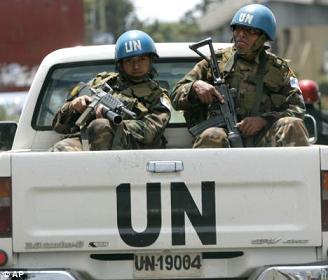
The MINUSTAH’s mandate was extended on October 15, 2014. It should be called an occupation force to reflect its true nature. From the outset its “peacekeeping” operations consisted in political repression of Fanmi Lavalas supporters. It recently fired live bullets on protesters:
During these ten years, MINUSTAH has compiled a horrific record of human rights abuses, including but not limited to extrajudicial murder, an epidemic of sexual assault against Haitian men, women and children, the repression of peaceful political protests, in addition to unleashing cholera through criminal negligence which has caused the death of over 9,000 people and infecting nearly a million more. (Dr. Ajamu Nangwaya and Kevin Edmonds, On October 15, the United Nations Will Fail Haiti Once Again, Global Research, October 14, 2014)
The Haitian Police is also trained by the U.S. private military and security contractor (PMSC) DynCorp.
In April 2013, DynCorp received a $48.6 million contract from the US State Department’s Bureau of International Narcotics and Law Enforcement Affairs, for a one-year base period with three one-year options, for the insertion of its trainees into the UN police force in Haiti. (Dady Chery, Reconstitution of Haiti’s Tontons Macoutes and Their Fusion With MINUSTAH, Haiti Chery, December 24, 2014)
Aid money for luxury hotels and new slums
According to the International Organization for Migration, 80,000 people were still living in camps in December 2014, a 92 per cent decrease since the beginning of the crisis when 1,5 million people were homeless. But the organization does not say where those who left the camps went.
One year ago Haiti Grass Roots Watch wrote that 200,000 earthquake victims had left the makeshift camps for “three large new slums called Canaan, Onaville and Jerusalem.” What about the housing projects paid for by generous donations?
Who lives in them? Who runs them? Can the residents afford the rents or mortgages? Are the residents the earthquake victims?
In total, the new housing projects, with homes for at least 3,588 families, cost US$ 88 million, according to government figures. (In contrast, international donors and private agencies spent more than five times that amount – about US$ 500 million – on “temporary shelters” or T-shelters.) …
On July 21 2011, President Martelly, former US President Bill Clinton and then-Prime Minister Jean Max Bellerive inaugurated the Housing Exposition: a fair featuring about 60 model homes in Zoranje.
Everyone agrees the Expo was a failure. Few visited the site and fewer still chose one of the model homes – many of which were very expensive by Haitian standards – for their project. (HAITI: Reconstruction’s Housing Projects Still Plagued with Problems Four Years After the Earthquake, Haiti Grassroots Watch January 8, 2014)
While hundreds of thousands of people were still living in makeshift camps, large sums of aid money were dedicated to the construction of luxury hotels. As we reported in 2013:
Now, as 300,000 Haitians are still living in camps, a “new Marriott hotel rising from the rubble in Haiti is getting a $26.5 million financial boost” from the International Financial Corporation (IFC), member of the World Bank Group…
The IFC is part of the World Bank Group. The World Bank has been criticized for previous initiatives like the Project for Participatory Community Development (PRODEP). An eight month investigation by Haiti Grassroots Watch found that PRODEP “helped undermine an already weak state, damaged Haiti’s ‘social tissue,’ carried out what could be called ‘social and political reengineering,’… raised questions of waste and corruption… contributed to Haiti’s growing status as an ‘NGO Republic’… damaged traditional solidarity systems and in some cases even strengthened the power of local elites.” (Julie Lévesque, Haiti “Reconstruction”: Luxury Hotels, Sweat Shops and Deregulation for the Foreign Corporate Elite, Global Research, August 16, 2013)
And in 2012:
As part of the country’s “Reconstruction”, The Clinton-Bush Haiti Fund recently invested $2 million in the Royal Oasis Hotel, a deluxe structure to be built in a poverty-stricken metropolitan area “filled with displaced-persons camps housing hundreds of thousands”. (Julie Lévesque, HAITI: Humanitarian Aid for Earthquake Victims Used to Build Five Star Hotels, Global Research, June 28, 2012)
The Royal Oasis, 5 star hotel.
In 2013 it was reported that “Haitians earn less today than they did under the Duvalier dictatorship”. Unless there were any changes within the last year, Haitians who work in the giant Caracol Industrial Park inaugurated in March 2013 end up with a meager US$ 1,36 a day after they paid for food and transportation. If exploitation was not enough, the construction of the giant garment sweatshop kicked farmers off one of the breadbaskets of Haiti when the country is in need of food.
HGW also learned that most of the farmers kicked off their plots to make way for the park are still without land.
“Before, Caracol was the breadbasket of the Northeast department,” said Breüs Wilcien, one of the farmers expelled from the 250-hectare zone. “Right now there is a shortage of some products in the local markets. We are just sitting here in misery.” (The Caracol Industrial Park: Worth the risk? Haiti Grassroots Watch, March 7, 2013)
The anchor tenant of Caracol is Korean apparel manufacturer Sae-A, which provides mass retailers such as Wallmart, and brands including Ralph Lauren, Donna Karen New York, Gap, Zara, Old Navy, H&M.
Haitians have once again been betrayed by the international community:
2015 finds Haitians fighting tooth and nail in renewed political mobilizations to create the nation-building project that big governments and aid agencies pledged but then cruelly betrayed…
[T]he promises of the multi-billion dollar international relief effort and aid which will reach the grassroots have proven largely illusory.
A key admission in the months following the earthquake was that democratic governance and national sovereignty were essential tools for building Haiti on a new and progressive foundation. Today, the lack of democracy and sovereignty is at the epicenter of the political firestorm sweeping the country. (Travis Ross and Roger Annis, Haiti’s Promised Rebuilding is Unfulfilled as Haitians Challenge Authoritarian Rule, Haïti Liberté  January 7, 2015)
Visit our Haiti in-depth report for more information.

Monday, December 8, 2014

« L’essence des médias n’est pas l’information. C’est le pouvoir. »

« L’essence des médias n’est pas l’information. C’est le pouvoir. »

Global Research, décembre 03, 2014
La semaine dernière, le célèbre journaliste John Pilger a participé à une série de Questions-Réponses avec Des Freedman (le 18 novembre 2014), membre de la Media Reform Coalition (coalition pour la réforme des média) ; c’était à l’occasion de la sortie du nouveau livre de Des Freedman « The Contradictions of Media Power » (les contradictions du pouvoir des médias.) Nous avons extrait les meilleures citations de cette intervention de John Pilger, ce qui donne un aperçu de son expérience et de sa compréhension du pouvoir des médias ; nous pouvons tous en apprendre. Et il a véritablement été brillant.

Aujourd’hui les médias sont, comme l’avait décrit le père de la propagande, Edward Bernays, « un gouvernement invisible ». Ils font partie du gouvernement. Ils défendent les intérêts du gouvernement. Le premier ministre est un chargé de relation publique de profession, et pas des meilleurs. C’est tout ce qu’il est. Il ne doit pas être pris au sérieux, c’est juste son rôle. Cette position lui confère certains aspects du pouvoir. Mais le véritable pouvoir réside dans la propagande et les médias. C’est aujourd’hui le cas sur la planète entière.
Durant les prémices de l’invasion de l’Irak, le journalisme a joué un rôle critique dans la concrétisation de l’invasion. Particulièrement aux USA, qui ont – selon la constitution – la presse la plus libre du monde.
Quand je discute de cela avec nombre de collègues distingués aux Etats-Unis et ici, à la suite de l’invasion, ils étaient unanimes, si les journalistes aux postes concernés, à la télévision et dans les journaux (surtout à la télévision, à cause de son pouvoir), si ils avaient contesté les mensonges, s’ils les avaient confrontés, s’ils avaient fait ce qu’est censé faire un journaliste, s’ils avaient, comme le dit Dan Rather de CBS – posé les questions critiques, au lieu d’amplifier et de faire écho aux mensonges, s’ils avaient fait leur travail, ils pensent tous que l’invasion n’aurait pas eu lieu. Le fait qu’ils disent ça, et il s’agit de membres éminents des médias des deux côtés de l’Atlantique, que si les journalistes avaient fait leur travail, l’invasion aurait pu ne pas avoir lieu, et des centaines de milliers de gens seraient encore en vie aujourd’hui. C’est le véritable pouvoir des médias.
Vous travaillez au sein d’un système qui est par nature hostile à la vérité. Je le dis sans ironie, je le pense vraiment. Il est hostile à la vérité. Il suffit de constater la réaction des médias face aux lanceurs d’alertes comme Edward Snowden, Julian Assange. La réaction amère de ceux qui font honte aux médias, tous en chœur.
Il y a ce qu’on appelle la censure par omission. Vous ne discutez pas de ce que vous choisissez d’ignorer, mais ça passe à la trappe.
Si vous remontez à 2008, les histoires sur BBC News, dans tous les journaux, les banques étaient soudainement des escrocs. Quand la Northern Rock s‘est effondrée, les banques étaient des escrocs, elles étaient toutes exposées. Le Guardian était rempli d’articles sépulcreux sur comment les banques étaient pourries de l’intérieur. C’était l’info du jour.
Un aperçu. Cette histoire s’est essoufflée après trois mois et fut totalement inversée, ce n’était plus les banquiers, mais le résultat d’une dette nationale et d’une narrative contrôlée qui était là et qui s’appelait austérité et cette dette devait être payée. Pourquoi ? Pourquoi devait-elle l’être ? Les gens que vous citez (46% des gens pensent que l’austérité va trop loin ou n’est pas nécessaire) c’est une majorité. Si vous obtenez cela dans les sondages, 46%, c’est une majorité. Cela prouve encore que la plupart des gens ont cerné les médias. Ils les ont cernés, en terme de guerre, d’économie, de mode de vie. Nous avons donc entre-aperçu la vérité sur cette criminalité massive, toute cette architecture pourrie s’était effondrée, enfin presque. Les banques furent nationalisées, sans conditions. La conscience des raisons pour lesquelles c’était arrivé, qui fut présente pendant environ 6 mois, fut, grâce à un système de propagande très efficace, totalement effacée. Ce n’était plus la faute des banques, mais « nôtre faute ».
Nous devrions arrêter d’utiliser le terme mainstream. C’est une appellation erronée. Nous en sommes toujours à regarder à travers ce prisme qu’on appelle mainstream. Ce n’est pas du tout mainstream. C’est en réalité extrême. Qu’y-a-t-il de plus extrême qu’une multitude d’institutions qui propagent des guerres illégales et voraces, des mensonges sur les politiques économiques. Qu’y-a-t-il e plus extrême que cela ? Il n’y a rien de mainstream là-dedans. Le plus grand institut de propagande, en Angleterre, c’est la BBC. Et ce parce qu’il est le plus connu. Il bénéficie de la plus grande crédibilité. Sa renommée est mondiale. Par certains aspects ça peut être mérité. Dans le domaine de l’actualité et des affaires courantes, ça ne l’est absolument pas. Et, encore une fois, ce n’est pas de l’ironie. Donc cette idée que l’on se concentre sur les démons, Murdoch, Le Daily Mail (assez mauvais)…d’une certaine façon le Mail et la BBC se complètent l’un l’autre et se suivent… il s’agit de comprendre le spectre de la propagande et la façon dont cela nous affecte.
Les journalistes doivent-ils représenter le peuple ? Oui, bien sûr, mais comme l’a dit Martha Gelhorn : « Tout journalisme doit se faire depuis la base, pas depuis le sommet ». Ce n’est quasiment jamais le cas. Et c’est quelque chose qu’il faut enseigner aux jeunes journalistes. Ces choses élémentaires que vous faites, les sources d’informations les plus fiables, la manière de chercher la vérité, doit se faire depuis la base. C’est mon expérience en tant que reporter. Et j’ai été amené à me rendre compte que ceux qui sont au-dessus de la base, particulièrement ceux d’en-haut, n’étaient pas des sources fiables d’information.
John Pilger

Article original en anglais :
Traduction Nicolas Casaux du 4eme singe